In order to have a productive discussion about climate change, I think it is important to put the ideas about climate change, the science behind climate change, the rhetoric about climate change, and the solution to climate change into context. Context is, according to the Oxford American Dictionary, a noun meaning, “the circumstances that form the setting of an event, statement, or idea, and in terms of which it can be fully understood and assessed.” This is the approach we need to take, and it is contrary to the popular way of promoting, or debunking climate change. All too often climate change is reported, or debated, or debunked with perspective; a “particular attitude toward, or way of regarding something; a point of view.” I believe we need to get past climate change perspectives, and be knowledgeable about the context of climate context before proceeding.
I want to begin with an excerpt from pp. 10-12 of Ken Miller’s latest book: Only a Theory: Evolution and the Battle For America’s Soul. (Viking Press, 2008).
Listening to Dr. Miller’s words you could easily envision the Scopes Trial of 1926, the national furor over the Kansas State Board of Education dropping evolution from its state science standards in 2000, or the recent history of Kitzmiller v. Dover (2005). I wish that were the case. I heard strains of Dr. Miller, (whom I had the pleasure of meeting for a second time in, ironically enough, New Orleans, Louisiana, over Spring Break) when Brad Hill emailed me this nugget:
"LA Bill: to enact R.S. 17:285.1, relative to curriculum and instruction; to provide relative to the teaching of scientific subjects in public elementary and secondary schools; to promote students' critical thinking skills and open discussion of scientific theories; to provide relative to support and guidance for teachers; to provide relative to textbooks and instructional materials; to provide for rules and regulations; to provide for effectiveness; and to provide for related matters. Be it enacted by the Legislature of Louisiana: Section 1. R.S. 17:285.1 is hereby enacted to read as follows: §285.1. Science education; development of critical thinking skills This Section shall be known and may be cited as the "Louisiana Science Education Act."
B.(1) The State Board of Elementary and Secondary Education, upon, request of a city, parish, or other local public school board, shall allow and assist teachers, principals, and other school administrators to create and foster an environment within public elementary and secondary schools that promotes critical thinking skills, logical analysis, and open and objective discussion of scientific theories being studied including, but not limited to, evolution, the origins of life, global warming, and human cloning."
I’m sure you’ve heard the saying, “Thank God for Mississippi”. We usually say grace over the Magnolia State when they eek out a lower position on the ladder when it comes to something like obesity rates (they’re 49th, we’re 48th), or percentage of citizens holding a high school and college degrees (75% and 19%, respectively for Alabama; versus 72.9% and 16.9%, respectively for our neighbors to the West). In this context, however, I'm thinking more about the geographic barrier between Louisiana and us. But really, how far is Baton Rouge from Montgomery, ideologically speaking? It turns out, not nearly far enough.
I really don’t get it. But I do think there are some valid reasons why people, and their elected officials, have issues with theories and scientific paradigms like climate change and evolution. I think it has something to do with scale. Let’s try something based on scale. Let’s see what we know (and how we know it) in the context of biological and temporal scale.
Listen to what eminent evolutionary biologist Richard Dawkins has to say about it in his 1996 book, The Blind Watchmaker. Check out pages XV-XVI of the preface. (I downloaded this entire book for free yesterday.)
Having thought about this stuff all day (and all night, and now, creeping well into this morning, I can see why theories or climate change models that explain 100s of years of data get muddled in a news cycle that lasts 12 to 24 hours and in election cycles that last between 2 and 6 years. Speaking of elections, let’s here some fuzzy answers to a pointed, but less than perfect question, about climate change. (Start watching around minute 29.)
http://www.youtube.com/watch?v=89FbCPzAsRA
I wanted to look at that science from the International Panel on Climate Change (IPCC), and the Summary to Policy Makers from 2007, the most definitive evidence and models we have regarding climate change are available on the web. Let's a take a look at the PDF version.
Perhaps this is why President Obama has made it clear that new energy research is essential to our economic recovery and our continued national development in the 21st Century. Take a look at what he had to say regarding energy in his first address to the joint houses of Congress. (Scan to minute 21.)
For one, the rhetoric is better; and Obama’s position is decidedly stronger. And why not? The data on climate change are quite straightforward. Take a look at the graphs on pp. 15-18 on the PDF of the IPPC Summary to Policy Makers, 2007.
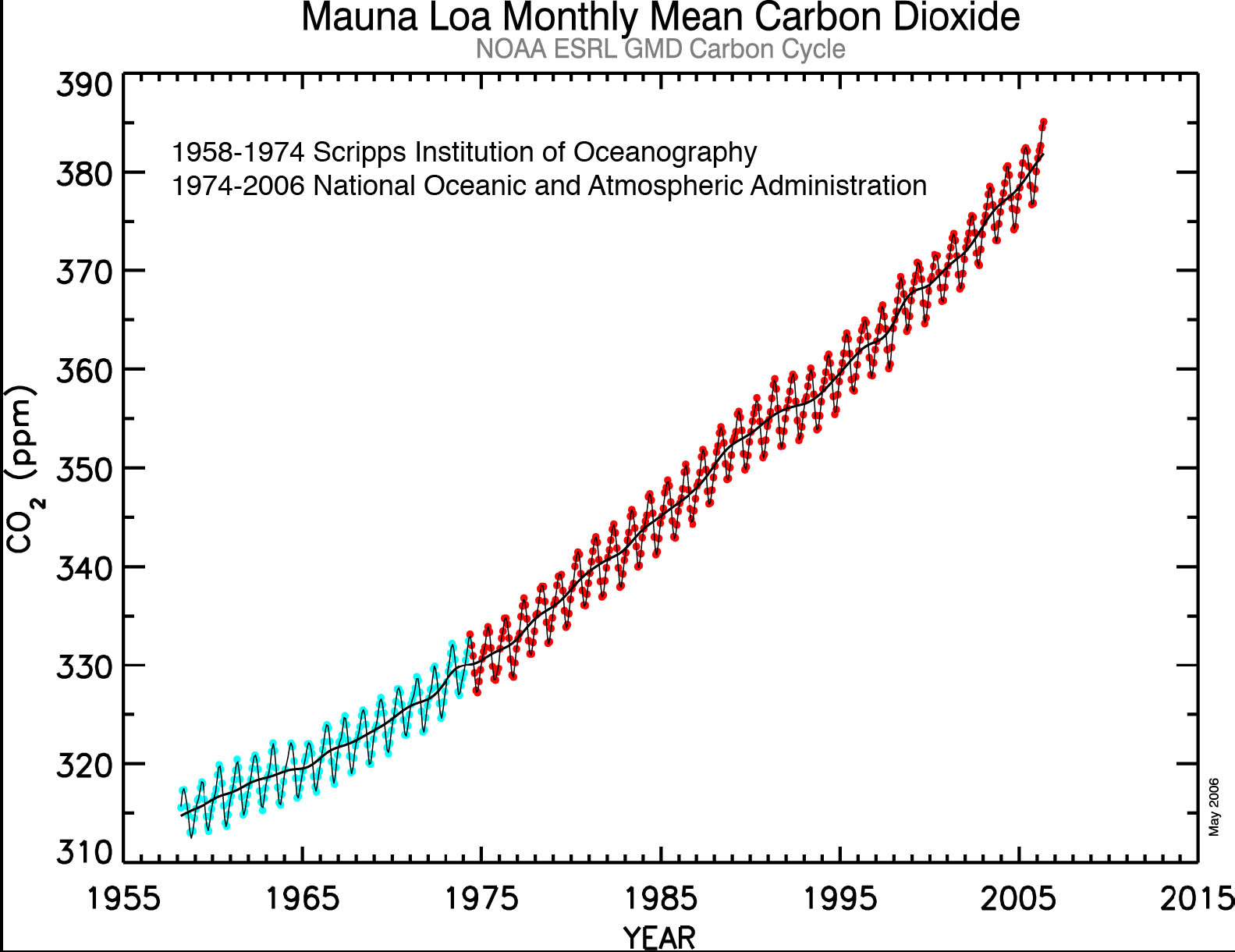
When discussing science, it’s always good to have a sense of skepticism, and to have multiple sources. Here are some corroborating evidence from the National Oceanic and Atmospheric Administration (NOAA), and an image of where they recorded the data.
Mauna Loa CO2 Concentrations
Mauna Loa Observatory
Some of the best evidence I have personally seen and heard comes not from the atmosphere or from sea level temperatures, but from the core of the earth itself. Take a look at what geophysicists from the University of Utah have uncovered by taking the temperature within the earth’s crust.
All of these collected data are have to be put into the context of a model. Several problems exist with models. First, they are only as good as the data they’re based on. Two, they get less accurate as the time scale increases. Third, several projections need to be placed in context with one another to account for natural changes in the climate and changed in human behavior. I don’t think this invalidates models, but do think we need to collect more data and educate people about the necessity and the limits of models. I want to take a minute to look at some of the simpler models from the IPCC 2007 Summary for Policymakers (SPM).
Models can be used in the popular media in a variety of ways. Al Gore used them to make a point and tell a story in An Inconvenient Truth. Glen Beck Dismisses them in his promo for his book, An Inconvenient Book.
The final contextual element deals with who is responsible for climate change and who is going to do something about it. Does the responsibility lie with Individuals?
With Entrepreneurs?
With Educators/Academia?
With Corporations?
With Local Regulatory boards?
With Regional Coalitions?
With the Federal Government?
With Multinational NGOs like the UN, IPCC, or the G20? I really don’t know. But I look forward to thinking more about it and learning more about this human scale.
This week we will focus on the behaviors of individuals and small groups and how that affects green house gas emissions. Next week I hope to gain a regional perspective on energy policy in the context of climate change. Finally, we’ll take a global view of climate change in the context of other issues I have discussed with you: human health and disease, water management, and food systems and food security.

Subscribe to:
Post Comments (Atom)
No comments:
Post a Comment