Unlike most mammals, teachers tend to hibernate in the summer. For the last 6 weeks, I've kept about 1/8 of my brain in touch with environmental issues in the 'Ham. Now, it's time to wake up and get back to work. Another B'ham News article about storm water quality came across my inbox this morning. The most salient points: 1) Shleby County can't manage it's storm water issues on it's own, and may be in violation of the Clean Water Act, and 2) Soon-to-be-bankrupt Jefferson County, is next in line for the same violations. Read the entire article here.
I learned a great tool for teaching environmental issues in Keystone, CO, this summer. It's called the PESTLE approach: Political, Economic, Social, Technical/Scientific, Legal, and Environmental. All of these varied interests bring valuabe insight to a discussion, and each interest has a stake in the outcome. If local county governments, business advocacy groups and environmental advocay groups can start (or continue) to take a PESTLE approach, we might be able to make some necessary changes to Alabama water issues.
Author's note; having worked closely with the Cahaba River Society, I can attest to the CRS's commitment to the political issues and economic interests of the region. It's time for local business leaders and politicians to take an honest look at the environmental, social and economic implications of poor environmental stewardship.
Tuesday, July 28, 2009

Thursday, May 21, 2009
The Beat Goes On
Life is what you make it. Technological tools are what you make them. Are the internet and the web 2.0 tools merely entertainment and diversions or can you actually learn something from them? This is something I'll be thinking about,exploring, and literally working through this summer and next fall.
I've made some cool connections with old aquantances via facebook that have produced fruitful discussions. Check out this link about food and fuel. It's nice to know other people are working this stuff out in their own church basements.
I've made some cool connections with old aquantances via facebook that have produced fruitful discussions. Check out this link about food and fuel. It's nice to know other people are working this stuff out in their own church basements.
Monday, May 11, 2009
Fog of War - The Movie!
Thanks to the magic of the internets (and the good folks at Google), here's The Fog of War in its entirety. This works especially well for those of you who have various tests this week and won't be able to watch some or all of the film in class.
Again, think in terms of empathy and parallels. Yes, there's a lot of history referenced -- some you may be familiar with and some you may be encountering for the first time. The important thing in the context of 21CC, though, is that you take a minute (or 107 of them) to think about Robert McNamara as a precursor to you, the 21C Challenger. He and his generation faced largescale issues; we face largescale issues. He had his ups and he had his downs, many of them on the largest of large scales. Pay attention to the eleven lessons the film enumerates but also see if you can't extract other lessons that are just as (more?) pertinent to your own experience.
And as Mr. Reardon suggested this morning, think about how interconnected our own "21C Challenges" are to what has come before. To wit: WWI leads to WWII leads to the Cold War leads to the Soviets in Afghanistan leads to Osama bin Laden's U.S.-aided paramilitary career leads to...21C Challenge. There are about a gazillion Matrushka dolls just like that one. Or at least four or five. (And perhaps the bin Laden sequence is an oversimplification, to some degree.) Point is, knowing the history is crucial. Just because there wasn't the internet for the vast majority of the 20C doesn't mean it's not relevant to our current circumstances.
Thursday, May 7, 2009
Chiming in...in the end
One of the great ironies of a school year is the need for an end/a break even though learning never stops. At some point I'd like to reflect and flesh out this idea; but for now just think about an unmentioned challenge: the pace and volume of new information.
I spent just a few minutes on the the Beitleblog and before I knew it, I was sucked into three parallel blogs (Steven Johnson's to name one). I just came up for air and shook my head. How do you remain educated, relevant, and focused in the digital age? I'm curious to know how all of you approach this question.
One more thread/comment (for now). If you want to look at some parallel perspectives to our 21st century challenges, check out dot earth. I think the author, Andrew C. Revkin, HAS been eavesdropping. Even if he hasn't been eavesdroppingt, it's good to know we've got friends out here.
I spent just a few minutes on the the Beitleblog and before I knew it, I was sucked into three parallel blogs (Steven Johnson's to name one). I just came up for air and shook my head. How do you remain educated, relevant, and focused in the digital age? I'm curious to know how all of you approach this question.
One more thread/comment (for now). If you want to look at some parallel perspectives to our 21st century challenges, check out dot earth. I think the author, Andrew C. Revkin, HAS been eavesdropping. Even if he hasn't been eavesdroppingt, it's good to know we've got friends out here.
Wednesday, May 6, 2009
Fog of War: Eleven Lessons from the Life of Robert McNamara

Next Wednesday and Thursday, you'll have the opportunity to watch a documentary film called Fog of War. (I say "opportunity" because you can beg off if you want to use the time to work on your final project and/or your blog.)
The film's about a man named Robert McNamara (as you may have guessed, that's him up there). McNamara had a varied and influential (some would say infamous) career in both the public and private sectors; he's most well-known for his service as the Secretary of Defense under presidents Kennedy and Johnson, but he was also the President of Ford Motor Company in the 1950s and he finished his career as head of the World Bank. Suffice it to say, if there was a class called "20th Century Challenges" he'd be the one to teach it because he had a front row seat to most of them, everything from the 1918 flu epidemic when he was a mere tot, all the way to WWII, the Sixties (and everything that portentous decade entailed), Vietnam and beyond.
I want to use this documentary -- this man -- to conclude our festivities for at least four reasons:
1. First, we spent last week talking about the role of government and I'd like you to continue thinking about what government is supposed to do -- what it does well -- and what it doesn't do well. I don't think there's a hard and fast answer to those questions, but I do want you thinking about them. As I said last week, we may very well be entering an era when the role of government, both here and abroad, is making a fundamental shift. There appears to be a prevailing sense -- right or wrong -- that government can and should do more. Fog of War is, I think, instructive when it comes to understanding both the potential and the limitations of governments and government officials, even (or perhaps especially) if they're really, really smart.
2. Speaking of really, really smart people: the second reason I want to show the film is because McNamara himself is not unlike you. He's really smart (and he knows it). As a young man, he was really ambitious and he wanted to have a role in solving the problems of his day. That worked out well in some respects (Seatbelts! Yay!) and not so well in other respects (Bay of Pigs, Gulf of Tonkin [:(]...boo!). Regardless, he collected a lot of insights from his varied experiences, his success and his failures, and I think those insights are useful for folks who want to give their talents and energy to tackling today's most vexing issues.
3. Oh yeah: vexing issues. I want to show this film because it drives home an important point. There have always been vexing issues. Some even more vexing than the ones we're facing now. It's not so much the issues themselves; it's how you approach them.
4. Last, I want us to consider one of McNamara's lessons in particular: "Rationality will not save us," he says. Much of this class has been about applying rationality -- reason, intention, Logos, whatever you want to call it -- to the challenges we've considered. I'll go on record as saying that we've got a dearth of rationality in our cultural ecosystem, and that's a problem. But here's a guy who structured his life around reason, facts, evidence -- a guy who applied those particular intellectual tools directly to the great conundrums of his time. He's the 20th century's poster boy of Logos. And yet at the end of the ride, he looks back on all of it and says, "Rationality will not save us." What on earth could he mean by that? I say we watch the film and find out.
Obama's Vietnam?

Speaking of Robert McNamara and, by association, Vietnam...and, by association, the idea that the government should be run by "the best and brightest" minds who see government as a powerful tool to effect real and meaningful change both at home and abroad...
Speaking of all that, it's tempting to draw parallels between the Kennedy administration and the Obama administration. Tempting and certainly not scientific. But, you know, interesting. And Kennedy -- for all his best-and-brightest, all his hope and optimism -- pretty much started the Vietnam War.
So here's a link to an article in today's Washington Post. It's an extensive consideration of the Obama administration's new, hard(er) line approach to Afghanistan, in particular to its increasingly controversial leader, Hamid Karzai.
I'm not smart enough to know what the true parallels between Afghanistan and Vietnam are (if there are any at all). I do know that that part of the world -- the higher-ups in the administration call it "Af-Pak," thereby throwing the ever-more volatile Pakistan into the mix -- presents some majorly thorny geopolitical issues (as did Vietnam), and it could all very well blow up in our collective face (as did Vietnam) if'n we're not careful.
Everything You Ever Wanted to Know about K-12 Public Education...
...but were smart enough not to ask. Some links:
On Teachers and Teaching
...Malcolm Gladwell writes in The New Yorker about how hiring good teachers is a lot like...drafting an NFL quarterback? Which is to say it's almost impossible to get right -- or at least the job requires such a wide (and weird) assortment of skills, it's impossible to know who's going to be good at it until they're actually doing the job. A pull quote: "In teaching, the implications are even more profound [than in the NFL or other similar fields where it's difficult to predict a candidate's future success]. They suggest that we shouldn’t be raising standards. We should be lowering them, because there is no point in raising standards if standards don’t track with what we care about. Teaching should be open to anyone with a pulse and a college degree—and teachers should be judged after they have started their jobs, not before."
On School Reform
...Here's an article in Slate about KIPP, which stands for Knowledge Is Power Program. KIPP is an ambitious school reform model that advocates higher standards and longer school days/weeks/years for economically disadvantaged kids in the public school system. Here's a link on the KIPP website to other articles about the program. The program is mostly lauded as a success but it has its detractors, who say its methods are harsh and that it can't be reproduced everywhere.
...Here's a Time article on Michelle Rhee, the chancellor of the notoriously underperforming Washington, D.C., public schools. Rhee's on a mission to reform that system -- primarily by weeding out bad teachers and paying good ones more money. Not surprisingly, teachers unions disapprove. (For what it's worth, here's an interesting little tidbit via the Washington Post on Rhee, uh, re: the Obama administration's approach to education policy. Let's just say she held her nose when she voted for Obama-Biden.)
...What's the common thread between these two reform models? The adminstrators involved are Teach for America vets. (They're also enamored of test scores as a primary determinant of school success.) Me, I'm a TFA skeptic. Most of my friends who've done it came away scarred from the experience (and that's to say nothing of the students involved!). Very young teachers with very little experience (teaching-wise or life-wise) or training + some of the nation's failingest schools = recipe for disaster. But that's just anecdotal. What do I know? I do think it's interesting how a group of young educational administrators seem to be cutting their teeth there (and in programs like it) and then using that dramatic/unique/harrowing experience to reimagine how we teach our kids. Good? Bad? Hrmmm. Both?
On No Child Left Behind
...A middle school administrator writes an op-ed on NCLB in the San Francisco Chronicle.
...What's NCLB, you ask? Why, it's this!
...And here's what the new Secretary of Education, Arne Duncan, thinks of it (and more), via an interview with Newsweek.
On Teachers and Teaching
...Malcolm Gladwell writes in The New Yorker about how hiring good teachers is a lot like...drafting an NFL quarterback? Which is to say it's almost impossible to get right -- or at least the job requires such a wide (and weird) assortment of skills, it's impossible to know who's going to be good at it until they're actually doing the job. A pull quote: "In teaching, the implications are even more profound [than in the NFL or other similar fields where it's difficult to predict a candidate's future success]. They suggest that we shouldn’t be raising standards. We should be lowering them, because there is no point in raising standards if standards don’t track with what we care about. Teaching should be open to anyone with a pulse and a college degree—and teachers should be judged after they have started their jobs, not before."
On School Reform
...Here's an article in Slate about KIPP, which stands for Knowledge Is Power Program. KIPP is an ambitious school reform model that advocates higher standards and longer school days/weeks/years for economically disadvantaged kids in the public school system. Here's a link on the KIPP website to other articles about the program. The program is mostly lauded as a success but it has its detractors, who say its methods are harsh and that it can't be reproduced everywhere.
...Here's a Time article on Michelle Rhee, the chancellor of the notoriously underperforming Washington, D.C., public schools. Rhee's on a mission to reform that system -- primarily by weeding out bad teachers and paying good ones more money. Not surprisingly, teachers unions disapprove. (For what it's worth, here's an interesting little tidbit via the Washington Post on Rhee, uh, re: the Obama administration's approach to education policy. Let's just say she held her nose when she voted for Obama-Biden.)
...What's the common thread between these two reform models? The adminstrators involved are Teach for America vets. (They're also enamored of test scores as a primary determinant of school success.) Me, I'm a TFA skeptic. Most of my friends who've done it came away scarred from the experience (and that's to say nothing of the students involved!). Very young teachers with very little experience (teaching-wise or life-wise) or training + some of the nation's failingest schools = recipe for disaster. But that's just anecdotal. What do I know? I do think it's interesting how a group of young educational administrators seem to be cutting their teeth there (and in programs like it) and then using that dramatic/unique/harrowing experience to reimagine how we teach our kids. Good? Bad? Hrmmm. Both?
On No Child Left Behind
...A middle school administrator writes an op-ed on NCLB in the San Francisco Chronicle.
...What's NCLB, you ask? Why, it's this!
...And here's what the new Secretary of Education, Arne Duncan, thinks of it (and more), via an interview with Newsweek.
More on Higher Ed and the Role of Government
This just in from NPR's Marketplace: Pennsylvania is the new Germany. Seems up there in the Keystone State they think some students don't care so much about food courts and fitness centers when it comes to choosing a college, and the powers-that-be in PA state government want to establish a new no-frills, low-cost college to meet that need. Just give me a solid education, man. Kind of like they do in Europe, where most of the colleges and universities are A) almost exclusively state funded and B) no frills.
In Germany, for instance, tuition can't be more than $1,300 a year -- and even then students are complaining that they're paying too much for college. They used to pay nothing. Of course, there are those in Germany -- particularly professors -- who want the higher education system there to be more like it is in -- you guessed it -- the U.S. No-frills higher ed is great, they say, as long as you don't want to have any MITs or Yales or Harvards.
In Germany, for instance, tuition can't be more than $1,300 a year -- and even then students are complaining that they're paying too much for college. They used to pay nothing. Of course, there are those in Germany -- particularly professors -- who want the higher education system there to be more like it is in -- you guessed it -- the U.S. No-frills higher ed is great, they say, as long as you don't want to have any MITs or Yales or Harvards.
Obama: You Are Entitled to Higher Ed
21CC yet again has its finger on the pulse of the body politic. Here's an article in today's WaPo on-line about the Obama administration's proposal to effectively make higher education a government subsidized "entitlement" for everybody who wants it. Seems you guys aren't the only ones who think all human beings on planet Earth are entitled to a little book learning.
Also check out the quote at the end from Rep. Timothy Bishop (D-N.Y.), "a former college provost and a member of Miller's committee, [who] said the lending proposal 'goes to the very heart of one's perception of what is the role of the federal government. And I think there will be a significant fight over it.'" Those italics are mine; the words are his, though. I didn't tell him to say that -- unless, of course, ol' Rep. Bishop's been reading the blog!
Also check out the quote at the end from Rep. Timothy Bishop (D-N.Y.), "a former college provost and a member of Miller's committee, [who] said the lending proposal 'goes to the very heart of one's perception of what is the role of the federal government. And I think there will be a significant fight over it.'" Those italics are mine; the words are his, though. I didn't tell him to say that -- unless, of course, ol' Rep. Bishop's been reading the blog!
Friday, May 1, 2009
"Social Safety Nets" According to the World Bank
Turns out not all "social safety nets" are created equal. Here's a link to an article on the World Bank's website regarding social safety nets and stimulus packages in the developing world. They seem to be of the opinion that if you provide a solid safety net, especially for the poor, it can have the effect of stimulating economic development.
Thursday, April 30, 2009
A Message from Our Sponsors
Here's what the good folks in charge of these big entitlement programs -- Social Security and Medicare -- had to say last year about their solvency:
[Click here for the full summary.]
___
A SUMMARY OF THE 2008 ANNUAL REPORTS
Social Security and Medicare Boards of Trustees
A MESSAGE TO THE PUBLIC:
Each year the Trustees of the Social Security and Medicare trust funds report on the current and projected financial status of the two programs. This message summarizes our 2008 Annual Reports.
The financial condition of the Social Security and Medicare programs remains problematic. Projected long run program costs are not sustainable under current financing arrangements. Social Security's current annual surpluses of tax income over expenditures will begin to decline in 2011 and then turn into rapidly growing deficits as the baby boom generation retires. Medicare's financial status is even worse. This year Medicare's Hospital Insurance (HI) Trust Fund is expected to pay out more in hospital benefits and other expenditures than it receives in taxes and other dedicated revenues. The difference will be made up from general revenues which pay for interest credits to the Trust Fund. Growing annual deficits are projected to exhaust HI reserves in 2019 and Social Security reserves in 2041. In addition, the Medicare Supplementary Medical Insurance (SMI) Trust Fund that pays for physician services and the prescription drug benefit will continue to require general revenue financing and charges on beneficiaries that grow substantially faster than the economy and beneficiary incomes over time.
The drawdown of Social Security and HI Trust Fund reserves and the general revenue transfers into SMI will result in mounting pressure on the Federal budget. In fact, pressure is already evident. For the second consecutive year, a "Medicare funding warning" is being triggered, signaling that non-dedicated sources of revenues—primarily general revenues—will soon account for more than 45 percent of Medicare's outlays. The President recently proposed remedial action pursuant to the warning in last year's report and, in accordance with Medicare statute, a Presidential proposal will be needed in response to the latest warning.
We are increasingly concerned about inaction on the financial challenges facing the Social Security and Medicare programs. The longer action is delayed, the greater will be the required adjustments, the larger the burden on future generations, and the more severe the detrimental economic impact on our nation.
_____
A summary of the summary? Run for your lives!!!
[Click here for the full summary.]
___
A SUMMARY OF THE 2008 ANNUAL REPORTS
Social Security and Medicare Boards of Trustees
A MESSAGE TO THE PUBLIC:
Each year the Trustees of the Social Security and Medicare trust funds report on the current and projected financial status of the two programs. This message summarizes our 2008 Annual Reports.
The financial condition of the Social Security and Medicare programs remains problematic. Projected long run program costs are not sustainable under current financing arrangements. Social Security's current annual surpluses of tax income over expenditures will begin to decline in 2011 and then turn into rapidly growing deficits as the baby boom generation retires. Medicare's financial status is even worse. This year Medicare's Hospital Insurance (HI) Trust Fund is expected to pay out more in hospital benefits and other expenditures than it receives in taxes and other dedicated revenues. The difference will be made up from general revenues which pay for interest credits to the Trust Fund. Growing annual deficits are projected to exhaust HI reserves in 2019 and Social Security reserves in 2041. In addition, the Medicare Supplementary Medical Insurance (SMI) Trust Fund that pays for physician services and the prescription drug benefit will continue to require general revenue financing and charges on beneficiaries that grow substantially faster than the economy and beneficiary incomes over time.
The drawdown of Social Security and HI Trust Fund reserves and the general revenue transfers into SMI will result in mounting pressure on the Federal budget. In fact, pressure is already evident. For the second consecutive year, a "Medicare funding warning" is being triggered, signaling that non-dedicated sources of revenues—primarily general revenues—will soon account for more than 45 percent of Medicare's outlays. The President recently proposed remedial action pursuant to the warning in last year's report and, in accordance with Medicare statute, a Presidential proposal will be needed in response to the latest warning.
We are increasingly concerned about inaction on the financial challenges facing the Social Security and Medicare programs. The longer action is delayed, the greater will be the required adjustments, the larger the burden on future generations, and the more severe the detrimental economic impact on our nation.
_____
A summary of the summary? Run for your lives!!!
The Future of Social Security and Medicare
Is Medicare going bankrupt in 2019 -- and, if so, what does that mean?
And they -- "they" being none other than the good folks at the Social Security Administration -- say the Social Security Trust Fund (whatever that is!) is going to be gone in 2041.
So should we all move to Sweden? Or just start stocking up the ammo and canned goods? Or is there something we can do to make these popular government programs solvent again?
And they -- "they" being none other than the good folks at the Social Security Administration -- say the Social Security Trust Fund (whatever that is!) is going to be gone in 2041.
So should we all move to Sweden? Or just start stocking up the ammo and canned goods? Or is there something we can do to make these popular government programs solvent again?
Tuesday, April 28, 2009
A Short Quiz
True/False
Government is a proper tool for establishing and maintaining a shared set of cultural values.
True/False
Reason is a fundamental value of our government.
True/False
Our government adapts to its context. ("Relativism" v. "Fundamentalism"?)
True/False
Our government solves difficult social problems.
Government is a proper tool for establishing and maintaining a shared set of cultural values.
True/False
Reason is a fundamental value of our government.
True/False
Our government adapts to its context. ("Relativism" v. "Fundamentalism"?)
True/False
Our government solves difficult social problems.
Case Studies in Entitlements: The Bills
Consider, if you will, a family. Five generations.
Bill, Sr. is 90 years old. He served as a mechanic on an aircraft carrier in the South Pacific during WWII. When the war ended, he returned home to Demopolis, Alabama, where he worked for forty-plus years as an auto mechanic. His wife, Martha, passed away ten years ago. He recently moved in with his son, Bill, Jr., who rents a two-bedroom house. The arrangement is proving tough to manage. Bill, Sr. has macular degeneration, moderate dementia, type-2 diabetes, severe arthritis in his hips, and several other age-related ailments. His doctor has advised Bill, Jr., that his father needs full-time care in a nursing home. Bill, Sr. has no appreciable debts or assets.
Bill, Jr. is 65 years old. Like his father before him, he is an auto mechanic in Demopolis. He makes $32,700 per year. Also like his father, he has health problems. He needs knee replacement surgery and the arthritis in his fingers is making it impossible for him to continue in the only job he's ever known. He takes medications for high cholesterol and asthma, and he had a mild heart attack six months ago. His place of employment does not offer retirement benefits. He is not married and has no appreciable debts or assets.
Bill III -- Bill, Jr.'s son -- is a 42-year-old fast food manager in Tuscaloosa making $28,200 per year. He has been diagnosed with schizophrenia and has been deemed permanently disabled. He is not married and is estranged from his only child, daughter Billie. He has no appreciable debts or assets.
Billie is Bill III's 20-year-old daughter. She left home immediately after graduating from high school, moving to Birmingham with her high school sweetheart, Beau, who took a job as an electrician's assistant at a construction company. Beau was recently killed in a car accident six months after they were married. Billie works as a convenience store clerk. She makes $14,000 per year with no health benefits, and she is five months pregnant. She wants to be a nurse.
So. What social safety nets are available to them? Get as specific about costs and benefits as you can, down to dollar figures if possible. Here are a few hints:
But don't let that limit you. If you can find other programs, more power to you.
I don't expect us to figure out all the answers here. One of the main points of this exercise is to see just how complicated it is for an individual to navigate through a government program. Hence, when you report back to the group, it will be just as valuable for you to enumerate the questions this process has raised for you.
Bill, Sr. is 90 years old. He served as a mechanic on an aircraft carrier in the South Pacific during WWII. When the war ended, he returned home to Demopolis, Alabama, where he worked for forty-plus years as an auto mechanic. His wife, Martha, passed away ten years ago. He recently moved in with his son, Bill, Jr., who rents a two-bedroom house. The arrangement is proving tough to manage. Bill, Sr. has macular degeneration, moderate dementia, type-2 diabetes, severe arthritis in his hips, and several other age-related ailments. His doctor has advised Bill, Jr., that his father needs full-time care in a nursing home. Bill, Sr. has no appreciable debts or assets.
Bill, Jr. is 65 years old. Like his father before him, he is an auto mechanic in Demopolis. He makes $32,700 per year. Also like his father, he has health problems. He needs knee replacement surgery and the arthritis in his fingers is making it impossible for him to continue in the only job he's ever known. He takes medications for high cholesterol and asthma, and he had a mild heart attack six months ago. His place of employment does not offer retirement benefits. He is not married and has no appreciable debts or assets.
Bill III -- Bill, Jr.'s son -- is a 42-year-old fast food manager in Tuscaloosa making $28,200 per year. He has been diagnosed with schizophrenia and has been deemed permanently disabled. He is not married and is estranged from his only child, daughter Billie. He has no appreciable debts or assets.
Billie is Bill III's 20-year-old daughter. She left home immediately after graduating from high school, moving to Birmingham with her high school sweetheart, Beau, who took a job as an electrician's assistant at a construction company. Beau was recently killed in a car accident six months after they were married. Billie works as a convenience store clerk. She makes $14,000 per year with no health benefits, and she is five months pregnant. She wants to be a nurse.
So. What social safety nets are available to them? Get as specific about costs and benefits as you can, down to dollar figures if possible. Here are a few hints:
But don't let that limit you. If you can find other programs, more power to you.
I don't expect us to figure out all the answers here. One of the main points of this exercise is to see just how complicated it is for an individual to navigate through a government program. Hence, when you report back to the group, it will be just as valuable for you to enumerate the questions this process has raised for you.
"Government Is the Problem"?
Contrast that with this.
Money quotes:
Reagan: “In this present crisis, government is not the solution to our problems. Government is the problem.”
Obama: “I ask you to believe. Believe in yourselves. Believe in each other. Believe in the future we can build together…you and I together, we’ll change the country and change the world.”
"Power to the People!" rhetoric in both cases, to be sure. But behind it are very different ideas about the role of government in everyday American lives.
Just to quantify it a little bit, here's a chart of the top U.S. income tax rates over time. The chart is courtesy of the Tax Policy Center, which is a joint venture of the Brookings Institution and the Urban Instititute. Check out where the top tax rate was in 1980 -- when President Reagan took office -- and where it was when he left in 1988. That, my friends, is a sea change.
It's early in this administration, but it looks like we might be in for a similar kind of sea change in the way our government goes about its business. It won't likely lead to top tax rates back up in the 70% range, but it may very well lead to some fundamental shifts in the three areas the Obama administration has emphasized so far: energy, education, and health care.
Reagan has had a lasting effect on how people look at the role of government. It will be interesting to see if Obama does something similar. If he doesn't, it won't be for lack of trying.
Monday, April 27, 2009
Abraham Lincoln, the Founding Fathers, and the Utility of Logos Versus Pathos
Consider, if you will, young Abe Lincoln's speech, "The Perpetuation of Our Political Institutions," which he gave to the Young Men's Lyceum of Springfield, Illinois on January 27, 1838. He was a mere political whippersnapper at this point, but the seeds of the civil unrest that would define his presidency were already sprouting. He spends much of the speech denouncing a recent spate of lynchings and mob law in far flung parts of the nation, then finishes by exhorting folks to turn their passions into a steadfast commitment to the rule of law and an unshakable faith in the wisdom of a reasonable government. Here's what he says. See if you buy it...
Another reason which once was; but which, to the same extent, is now no more, has done much in maintaining our institutions thus far. I mean the powerful influence which the interesting scenes of the revolution had upon the passions of the people as distinguished from their judgment. By this influence, the jealousy, envy, and avarice, incident to our nature, and so common to a state of peace, prosperity, and conscious strength, were, for the time, in a great measure smothered and rendered inactive; while the deep-rooted principles of hate, and the powerful motive of revenge, instead of being turned against each other, were directed exclusively against the British nation. And thus, from the force of circumstances, the basest principles of our nature, were either made to lie dormant, or to become the active agents in the advancement of the noblest cause -- that of establishing and maintaining civil and religious liberty.
But this state of feeling must fade, is fading, has faded, with the circumstances that produced it...Passion has helped us; but can do so no more. It will in future be our enemy. Reason, cold, calculating, unimpassioned reason, must furnish all the materials for our future support and defence. -- Let those materials be moulded into general intelligence, sound morality, and in particular, a reverence for the constitution and laws: and, that we improved to the last; that we remained free to the last; that we revered his name to the last; that, during his long sleep, we permitted no hostile foot to pass over or desecrate his resting place; shall be that which to learn the last trump shall awaken our WASHINGTON.
Upon these let the proud fabric of freedom rest, as the rock of its basis; and as truly as has been said of the only greater institution, "the gates of hell shall not prevail against it."
We the People
FYI: the preamble to the Constititution...
"We the People of the United States, in Order to form a more perfect Union, establish Justice, insure domestic Tranquility, provide for the common defence, promote the general Welfare, and secure the Blessings of Liberty to ourselves and our Posterity, do ordain and establish this Constitution for the United States of America."
"We the People of the United States, in Order to form a more perfect Union, establish Justice, insure domestic Tranquility, provide for the common defence, promote the general Welfare, and secure the Blessings of Liberty to ourselves and our Posterity, do ordain and establish this Constitution for the United States of America."
Sunday, April 26, 2009
The Role of Government in the 21C
We conclude our Magical Mystery Tour by considering the mechanisms We the People (!) will use to address the 21C challenges we face. Of course, there is no bigger mechanism than The Government. But how and when and why will Government help discover solutions to our problems? And what about the 21C challenges Government itself is facing?
That's what this week will be about. We're going to talk a little bit about what governments in general are supposed to do (this will surely be a matter of some debate) and what our government in particular has promised it will do. Then we're going to look at some specific promises -- namely Social Security, Medicare, and Medicaid -- that are looking a little shaky here of late.
Lots to do in a week. Chances are it'll leak over into next week. Next week we'll also touch on another governmental "promise," public education. (Talk about 21C challenges!)
For now, here's a link to The National Archives "Charters of Freedom" site, which has full text versions of the Declaration of Independence and the Constitution as well as other pertinent links related to those seminal documents. I figure if we're trying to decide what our government should do, we oughtta begin at the beginning.
That's what this week will be about. We're going to talk a little bit about what governments in general are supposed to do (this will surely be a matter of some debate) and what our government in particular has promised it will do. Then we're going to look at some specific promises -- namely Social Security, Medicare, and Medicaid -- that are looking a little shaky here of late.
Lots to do in a week. Chances are it'll leak over into next week. Next week we'll also touch on another governmental "promise," public education. (Talk about 21C challenges!)
For now, here's a link to The National Archives "Charters of Freedom" site, which has full text versions of the Declaration of Independence and the Constitution as well as other pertinent links related to those seminal documents. I figure if we're trying to decide what our government should do, we oughtta begin at the beginning.
Tuesday, April 21, 2009
Flex Day 1: Water for thought
Rather than just kill time while half the class is away, I want to give you guys a chance to work on your Green Energy ads, or think and write about local water issues (we can't get away from them). This is a link to a recent article in the Birmingham News about hard times for SWMA, the Storm Water Management Association. (Full disclosure: the CRS is against this move. Notice that both Dr. Haddock and Ms. Stewart from the CRS are quoted as being against this development. Both of Dr. Haddock and Ms. Stewart have aaddressed students in this room since the beginning of the year.)
Fortunately, even some county officials have reservations about Jefferson County's decision. Take a look at today's article on SWMA. It's interesting to see a local challenge unfold right in front of us. All you have to do is look around a little.
Here's the prompt: what do you think about Jefferson County pulling out of SWMA? What are some potential drawbacks for citizens of Jefferson County, and for citizens downstream?
Next week Mr. Beitleman will begin a unit on "The Individual and the State." In this situation, water issues are colliding with current (and past) government action. It's interesting stuff. How should individuals get involved in local issues? What is the role of government?
Fortunately, even some county officials have reservations about Jefferson County's decision. Take a look at today's article on SWMA. It's interesting to see a local challenge unfold right in front of us. All you have to do is look around a little.
Here's the prompt: what do you think about Jefferson County pulling out of SWMA? What are some potential drawbacks for citizens of Jefferson County, and for citizens downstream?
Next week Mr. Beitleman will begin a unit on "The Individual and the State." In this situation, water issues are colliding with current (and past) government action. It's interesting stuff. How should individuals get involved in local issues? What is the role of government?
Sunday, April 19, 2009
Pitching Green Energy

When you design your ad, keep the following ideas in mind.
Regional or State Theme.
Use of Regional Renewable Resources.
How your business will cut CO2 emmissions (be quantitative if possible).
Benefits to customers and non-customers.
Fine print: how your business will help the state and region comply with federal environmental laws.
Finer print: what federal or state incentives are neccesary to insure your company's viablity.
Finest print: don't do a powerpoint. That's so "perpetual marketplace".
Blog Numbers
FYI...
Avg. # Total Blog Posts: 11.14
High: 17 (Tina!)
Low: 2 (...)
I know things are only going to get more hectic as we proceed, hence this "ask" is probably so much pie-in-the-sky. However. When we evaluate the blogs for the last time (on or about May 8), I'd say twenty posts for the semester is a great number. Fifteen is pretty good. Anything less than that and it's a safe bet that you pretty much blew off the whole blog thing. There are worse crimes, of course. (I mean...I can't think of any off the top of my head, but I'm sure there are worse ones....) Seriously, though, let's try to sprint to the finish line. Or at least let's jog there.
Avg. # Total Blog Posts: 11.14
High: 17 (Tina!)
Low: 2 (...)
I know things are only going to get more hectic as we proceed, hence this "ask" is probably so much pie-in-the-sky. However. When we evaluate the blogs for the last time (on or about May 8), I'd say twenty posts for the semester is a great number. Fifteen is pretty good. Anything less than that and it's a safe bet that you pretty much blew off the whole blog thing. There are worse crimes, of course. (I mean...I can't think of any off the top of my head, but I'm sure there are worse ones....) Seriously, though, let's try to sprint to the finish line. Or at least let's jog there.
Thursday, April 16, 2009
Going "meta"
Rachele definitely get's the point for citing the Spanish Tragedy from the mid 1500s as the first documented case of a play within a play. Upon further research she learned that particular Spanish play influenced Shakespeare, who used the "play within a play" device in Hamlet. Well done, everyone.
Now, we need to get down to the image adorning yesterday's post. Here are two hints as to why I picked that image. One, the people in the image are actors known the world over for playing the Vonn Trapp family. Second hint is: Gwen Stefani.
I hope the regional energy prospectus is going well. I will see you all tonight or tomorrow.
Now, we need to get down to the image adorning yesterday's post. Here are two hints as to why I picked that image. One, the people in the image are actors known the world over for playing the Vonn Trapp family. Second hint is: Gwen Stefani.
I hope the regional energy prospectus is going well. I will see you all tonight or tomorrow.
Tuesday, April 14, 2009
Climate Change Part 2: Regional Energy

I threw a lot at you guys on Tuesday morning. Sorry about that. That "performance" was a combination of viral hangover, sleep deprivation, and trying to get about an hours worth of discussion into thirty minutes. (A note to all you clock watchers, I know it's right above my head and I can see y'all checking it out. Remember, the hands don't move any faster if you look at them every 60 seconds!)
In the tradition of a "play within a play" (a bonus point for whoever can tell me when that device was first used), I wanted to offer a "post within a post". The three points below are the meat of our second week on climate change. We'll get to work first thing Wednesday morning.
1) Get the basic information on the availability, technology, economics/politics, and environmental issues surrounding non-renewable and renewable energy.
2) Draft a regional energy policy prospectus that takes climate and resource availability into account.
3) Design an advertisement or presentation and pitch a “green energy” or renewable energy company in the region you’ve been assigned.
For objective one, don't reinvent the wheel. I've got these great things called "text books" in the room. Miller's Living In The Environment isn't perfect, but he does a great job outlining the basic science of energy and digests the important points on renewable and non renewable resources. I would start with Miller, then jump to the web for more focused information on regional energy resources.
You know what would be cool? Contact some of your friends and/or alums from ASFA living in the region you are researching and get their take on regional energy issues. Ask them about bottom-up (and top-down) energy movements.
Happy researching. Remember, if you don't know, ask.
Climate Change Part 2: Regional Energy
Regardless of what climate change naysayers want to say (I guess they say “nay”), the scientific community is in agreement that the global climate is warming at an unprecedented rate (IPPC, Summary for Policy Makers, 2007); and that CO2 emissions are one of the primary drivers (ibid).
Transportation and electricity generation are two of the major sources of CO2 emissions. There are some practical, individual decisions that can curb transportation emissions: carpooling, changing vehicles, making an intentional decision to live closer to work. That’s what last week’s assignment tackled. This week we’re going to scale up to regional CO2 emissions, and focus on energy (or electricity) generation.
Electricity generation is all about net energy (net energy is the amount of high-quality usable energy available from a resource after subtracting the energy needed to make it available for use (Miller, 2005). Clearly coal, natural gas and oil have high net energy (and it is worth noting that as technology improves, the net energy may increase); however, the CO2 emissions from combusting the fossil fuels may be the limiting factor on their usefulness. As the US, and the rest of the world, move into the 21st Century we need to diversify our energy resources and tap into renewable energy resources like wind, solar, geothermal, tidal, and even biofuels.
Taking my cue from Mr. Beitleman’s “Axis of Evil” module, I want us to be informed and intelligent about our potential energy sources. We will also use my Regional Water Summit model as we approach today’s energy challenges. By the end of the module we will accomplish the following three objectives:
1) Get the basic information on the availability, technology, economics/politics, and environmental issues surrounding non-renewable and renewable energy.
2) Draft a regional energy policy prospectus that takes climate and resource availability into account.
3) Design an advertisement or presentation and pitch a “green energy” or renewable energy company in the region you’ve been assigned.
Our first order of business is to get the basic information on energy resources. Use the matrices provided in class to guide your research. Although you will work in your “regional team”, you should take a national/global approach to energy resources. As your work progesses, I want you will focus on regional energy resources. My hope is that you all will draft smart, sustainable energy policies. Okay, that is a ridiculous goal, but at least we can get a feel for the issues.
Transportation and electricity generation are two of the major sources of CO2 emissions. There are some practical, individual decisions that can curb transportation emissions: carpooling, changing vehicles, making an intentional decision to live closer to work. That’s what last week’s assignment tackled. This week we’re going to scale up to regional CO2 emissions, and focus on energy (or electricity) generation.
Electricity generation is all about net energy (net energy is the amount of high-quality usable energy available from a resource after subtracting the energy needed to make it available for use (Miller, 2005). Clearly coal, natural gas and oil have high net energy (and it is worth noting that as technology improves, the net energy may increase); however, the CO2 emissions from combusting the fossil fuels may be the limiting factor on their usefulness. As the US, and the rest of the world, move into the 21st Century we need to diversify our energy resources and tap into renewable energy resources like wind, solar, geothermal, tidal, and even biofuels.
Taking my cue from Mr. Beitleman’s “Axis of Evil” module, I want us to be informed and intelligent about our potential energy sources. We will also use my Regional Water Summit model as we approach today’s energy challenges. By the end of the module we will accomplish the following three objectives:
1) Get the basic information on the availability, technology, economics/politics, and environmental issues surrounding non-renewable and renewable energy.
2) Draft a regional energy policy prospectus that takes climate and resource availability into account.
3) Design an advertisement or presentation and pitch a “green energy” or renewable energy company in the region you’ve been assigned.
Our first order of business is to get the basic information on energy resources. Use the matrices provided in class to guide your research. Although you will work in your “regional team”, you should take a national/global approach to energy resources. As your work progesses, I want you will focus on regional energy resources. My hope is that you all will draft smart, sustainable energy policies. Okay, that is a ridiculous goal, but at least we can get a feel for the issues.
Wednesday, April 8, 2009
Personal Energy Consumption/Carbon Emmisions

I. Use this post as a guide and an answer sheet for your fossil fuel/CO2 emmisions audit.
II. You need to turn the following two tables with your analysis.
A. A table with all 21CC student vehicle info, vehicle fuel economy, daily, weekly and annual commutes, annual gas consumption, Annual Energy Impact (Oil Consumption – in barrels/year)), Annual Green House Gas (GHG) Emissions also expressed as “Carbon Footprint”, Vehicle Air Pollution Score.
B. A table with all of your cohort’s vehicle info, vehicle fuel economy, daily, weekly and annual commutes, annual gas consumption, Annual Energy Impact (Oil Consumption), Annual Green House Gas (GHG) Emissions, Vehicle Air Pollution Score.
(You are welcome to turn in 1 table for the entire class, and 1 table for each specialty, but everyone must sign the table. You will have to communicate and work together on this. Make sure there is a column than indicates who did the research on the vehicle/energy consumption. Student initials will be fine.)
IIb. Where do you get this data? I have used www.fueleconomy.gov in the past and found everything I need on fuel economy. I also went to http://bioenergy.ornl.gov/papers/misc/energy_conv.html for conversion factors.
You all will have to do some research to find the average price of gasline in Alabama/Jefferson Co over the past five years (for one of the analysis questions).
See next page/handout for analysis questions. I would like you to post your answers to these questions as a comment to this post, that way we can all see eachothers' responses.
Sunday, April 5, 2009
The Context of Climate Change
In order to have a productive discussion about climate change, I think it is important to put the ideas about climate change, the science behind climate change, the rhetoric about climate change, and the solution to climate change into context. Context is, according to the Oxford American Dictionary, a noun meaning, “the circumstances that form the setting of an event, statement, or idea, and in terms of which it can be fully understood and assessed.” This is the approach we need to take, and it is contrary to the popular way of promoting, or debunking climate change. All too often climate change is reported, or debated, or debunked with perspective; a “particular attitude toward, or way of regarding something; a point of view.” I believe we need to get past climate change perspectives, and be knowledgeable about the context of climate context before proceeding.
I want to begin with an excerpt from pp. 10-12 of Ken Miller’s latest book: Only a Theory: Evolution and the Battle For America’s Soul. (Viking Press, 2008).
Listening to Dr. Miller’s words you could easily envision the Scopes Trial of 1926, the national furor over the Kansas State Board of Education dropping evolution from its state science standards in 2000, or the recent history of Kitzmiller v. Dover (2005). I wish that were the case. I heard strains of Dr. Miller, (whom I had the pleasure of meeting for a second time in, ironically enough, New Orleans, Louisiana, over Spring Break) when Brad Hill emailed me this nugget:
"LA Bill: to enact R.S. 17:285.1, relative to curriculum and instruction; to provide relative to the teaching of scientific subjects in public elementary and secondary schools; to promote students' critical thinking skills and open discussion of scientific theories; to provide relative to support and guidance for teachers; to provide relative to textbooks and instructional materials; to provide for rules and regulations; to provide for effectiveness; and to provide for related matters. Be it enacted by the Legislature of Louisiana: Section 1. R.S. 17:285.1 is hereby enacted to read as follows: §285.1. Science education; development of critical thinking skills This Section shall be known and may be cited as the "Louisiana Science Education Act."
B.(1) The State Board of Elementary and Secondary Education, upon, request of a city, parish, or other local public school board, shall allow and assist teachers, principals, and other school administrators to create and foster an environment within public elementary and secondary schools that promotes critical thinking skills, logical analysis, and open and objective discussion of scientific theories being studied including, but not limited to, evolution, the origins of life, global warming, and human cloning."
I’m sure you’ve heard the saying, “Thank God for Mississippi”. We usually say grace over the Magnolia State when they eek out a lower position on the ladder when it comes to something like obesity rates (they’re 49th, we’re 48th), or percentage of citizens holding a high school and college degrees (75% and 19%, respectively for Alabama; versus 72.9% and 16.9%, respectively for our neighbors to the West). In this context, however, I'm thinking more about the geographic barrier between Louisiana and us. But really, how far is Baton Rouge from Montgomery, ideologically speaking? It turns out, not nearly far enough.
I really don’t get it. But I do think there are some valid reasons why people, and their elected officials, have issues with theories and scientific paradigms like climate change and evolution. I think it has something to do with scale. Let’s try something based on scale. Let’s see what we know (and how we know it) in the context of biological and temporal scale.
Listen to what eminent evolutionary biologist Richard Dawkins has to say about it in his 1996 book, The Blind Watchmaker. Check out pages XV-XVI of the preface. (I downloaded this entire book for free yesterday.)
Having thought about this stuff all day (and all night, and now, creeping well into this morning, I can see why theories or climate change models that explain 100s of years of data get muddled in a news cycle that lasts 12 to 24 hours and in election cycles that last between 2 and 6 years. Speaking of elections, let’s here some fuzzy answers to a pointed, but less than perfect question, about climate change. (Start watching around minute 29.)
http://www.youtube.com/watch?v=89FbCPzAsRA
I wanted to look at that science from the International Panel on Climate Change (IPCC), and the Summary to Policy Makers from 2007, the most definitive evidence and models we have regarding climate change are available on the web. Let's a take a look at the PDF version.
Perhaps this is why President Obama has made it clear that new energy research is essential to our economic recovery and our continued national development in the 21st Century. Take a look at what he had to say regarding energy in his first address to the joint houses of Congress. (Scan to minute 21.)
For one, the rhetoric is better; and Obama’s position is decidedly stronger. And why not? The data on climate change are quite straightforward. Take a look at the graphs on pp. 15-18 on the PDF of the IPPC Summary to Policy Makers, 2007.
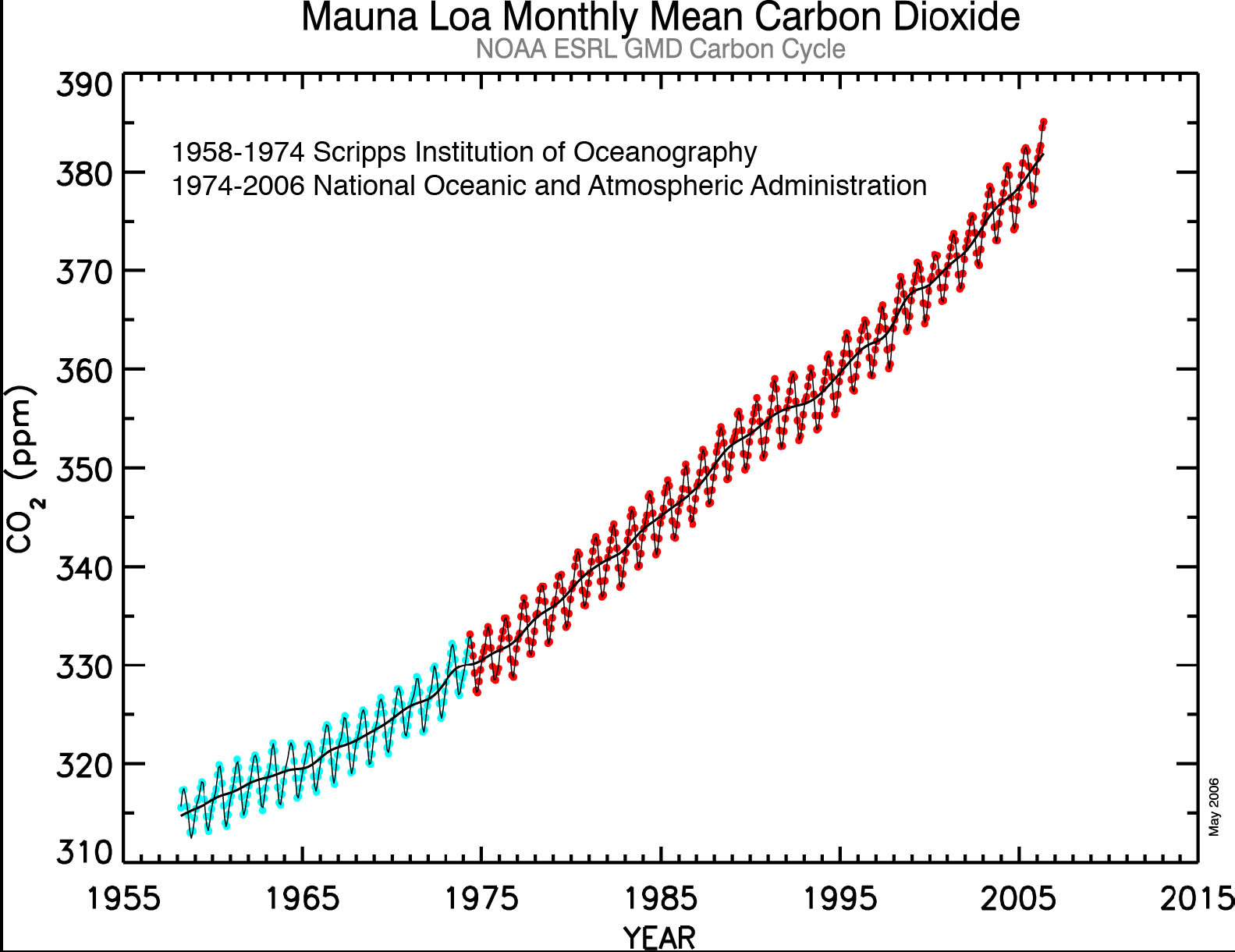
When discussing science, it’s always good to have a sense of skepticism, and to have multiple sources. Here are some corroborating evidence from the National Oceanic and Atmospheric Administration (NOAA), and an image of where they recorded the data.
Mauna Loa CO2 Concentrations
Mauna Loa Observatory
Some of the best evidence I have personally seen and heard comes not from the atmosphere or from sea level temperatures, but from the core of the earth itself. Take a look at what geophysicists from the University of Utah have uncovered by taking the temperature within the earth’s crust.
All of these collected data are have to be put into the context of a model. Several problems exist with models. First, they are only as good as the data they’re based on. Two, they get less accurate as the time scale increases. Third, several projections need to be placed in context with one another to account for natural changes in the climate and changed in human behavior. I don’t think this invalidates models, but do think we need to collect more data and educate people about the necessity and the limits of models. I want to take a minute to look at some of the simpler models from the IPCC 2007 Summary for Policymakers (SPM).
Models can be used in the popular media in a variety of ways. Al Gore used them to make a point and tell a story in An Inconvenient Truth. Glen Beck Dismisses them in his promo for his book, An Inconvenient Book.
The final contextual element deals with who is responsible for climate change and who is going to do something about it. Does the responsibility lie with Individuals?
With Entrepreneurs?
With Educators/Academia?
With Corporations?
With Local Regulatory boards?
With Regional Coalitions?
With the Federal Government?
With Multinational NGOs like the UN, IPCC, or the G20? I really don’t know. But I look forward to thinking more about it and learning more about this human scale.
This week we will focus on the behaviors of individuals and small groups and how that affects green house gas emissions. Next week I hope to gain a regional perspective on energy policy in the context of climate change. Finally, we’ll take a global view of climate change in the context of other issues I have discussed with you: human health and disease, water management, and food systems and food security.
I want to begin with an excerpt from pp. 10-12 of Ken Miller’s latest book: Only a Theory: Evolution and the Battle For America’s Soul. (Viking Press, 2008).
Listening to Dr. Miller’s words you could easily envision the Scopes Trial of 1926, the national furor over the Kansas State Board of Education dropping evolution from its state science standards in 2000, or the recent history of Kitzmiller v. Dover (2005). I wish that were the case. I heard strains of Dr. Miller, (whom I had the pleasure of meeting for a second time in, ironically enough, New Orleans, Louisiana, over Spring Break) when Brad Hill emailed me this nugget:
"LA Bill: to enact R.S. 17:285.1, relative to curriculum and instruction; to provide relative to the teaching of scientific subjects in public elementary and secondary schools; to promote students' critical thinking skills and open discussion of scientific theories; to provide relative to support and guidance for teachers; to provide relative to textbooks and instructional materials; to provide for rules and regulations; to provide for effectiveness; and to provide for related matters. Be it enacted by the Legislature of Louisiana: Section 1. R.S. 17:285.1 is hereby enacted to read as follows: §285.1. Science education; development of critical thinking skills This Section shall be known and may be cited as the "Louisiana Science Education Act."
B.(1) The State Board of Elementary and Secondary Education, upon, request of a city, parish, or other local public school board, shall allow and assist teachers, principals, and other school administrators to create and foster an environment within public elementary and secondary schools that promotes critical thinking skills, logical analysis, and open and objective discussion of scientific theories being studied including, but not limited to, evolution, the origins of life, global warming, and human cloning."
I’m sure you’ve heard the saying, “Thank God for Mississippi”. We usually say grace over the Magnolia State when they eek out a lower position on the ladder when it comes to something like obesity rates (they’re 49th, we’re 48th), or percentage of citizens holding a high school and college degrees (75% and 19%, respectively for Alabama; versus 72.9% and 16.9%, respectively for our neighbors to the West). In this context, however, I'm thinking more about the geographic barrier between Louisiana and us. But really, how far is Baton Rouge from Montgomery, ideologically speaking? It turns out, not nearly far enough.
I really don’t get it. But I do think there are some valid reasons why people, and their elected officials, have issues with theories and scientific paradigms like climate change and evolution. I think it has something to do with scale. Let’s try something based on scale. Let’s see what we know (and how we know it) in the context of biological and temporal scale.
Listen to what eminent evolutionary biologist Richard Dawkins has to say about it in his 1996 book, The Blind Watchmaker. Check out pages XV-XVI of the preface. (I downloaded this entire book for free yesterday.)
Having thought about this stuff all day (and all night, and now, creeping well into this morning, I can see why theories or climate change models that explain 100s of years of data get muddled in a news cycle that lasts 12 to 24 hours and in election cycles that last between 2 and 6 years. Speaking of elections, let’s here some fuzzy answers to a pointed, but less than perfect question, about climate change. (Start watching around minute 29.)
http://www.youtube.com/watch?v=89FbCPzAsRA
I wanted to look at that science from the International Panel on Climate Change (IPCC), and the Summary to Policy Makers from 2007, the most definitive evidence and models we have regarding climate change are available on the web. Let's a take a look at the PDF version.
Perhaps this is why President Obama has made it clear that new energy research is essential to our economic recovery and our continued national development in the 21st Century. Take a look at what he had to say regarding energy in his first address to the joint houses of Congress. (Scan to minute 21.)
For one, the rhetoric is better; and Obama’s position is decidedly stronger. And why not? The data on climate change are quite straightforward. Take a look at the graphs on pp. 15-18 on the PDF of the IPPC Summary to Policy Makers, 2007.
When discussing science, it’s always good to have a sense of skepticism, and to have multiple sources. Here are some corroborating evidence from the National Oceanic and Atmospheric Administration (NOAA), and an image of where they recorded the data.
Mauna Loa CO2 Concentrations
Mauna Loa Observatory
Some of the best evidence I have personally seen and heard comes not from the atmosphere or from sea level temperatures, but from the core of the earth itself. Take a look at what geophysicists from the University of Utah have uncovered by taking the temperature within the earth’s crust.
All of these collected data are have to be put into the context of a model. Several problems exist with models. First, they are only as good as the data they’re based on. Two, they get less accurate as the time scale increases. Third, several projections need to be placed in context with one another to account for natural changes in the climate and changed in human behavior. I don’t think this invalidates models, but do think we need to collect more data and educate people about the necessity and the limits of models. I want to take a minute to look at some of the simpler models from the IPCC 2007 Summary for Policymakers (SPM).
Models can be used in the popular media in a variety of ways. Al Gore used them to make a point and tell a story in An Inconvenient Truth. Glen Beck Dismisses them in his promo for his book, An Inconvenient Book.
The final contextual element deals with who is responsible for climate change and who is going to do something about it. Does the responsibility lie with Individuals?
With Entrepreneurs?
With Educators/Academia?
With Corporations?
With Local Regulatory boards?
With Regional Coalitions?
With the Federal Government?
With Multinational NGOs like the UN, IPCC, or the G20? I really don’t know. But I look forward to thinking more about it and learning more about this human scale.
This week we will focus on the behaviors of individuals and small groups and how that affects green house gas emissions. Next week I hope to gain a regional perspective on energy policy in the context of climate change. Finally, we’ll take a global view of climate change in the context of other issues I have discussed with you: human health and disease, water management, and food systems and food security.
N. Korea Update
N. Korea has, in fact, followed up on its threat/promise and tried to launch a "satellite" into "orbit." Didn't work, exactly, but it has started the geopolitical posturing. Here's the NY Times' account. Note that 1) the test failed, 2) it did extend the possible range N. Korea could launch something, 3) they are years away from intercontinental missile capabilities.
Thursday, April 2, 2009
Blog-On: Culture of Fear
Please mull over one of this week's posts and comment in the comments section of that particular post. Posts in question: Steven Pinker; Axis of Evil/War on Terror; DeLillo on 9/11; WTC-- 9/11.
Steven Pinker on the Decline of Violence
Steven Pinker is a professor of psychology at Harvard. Click here for his Harvard website, which has lots of bio information and interviews, etc. This is a talk he gave at the annual TED conference. TED stands for "Technology, Entertainment, Design" and it's basically a weeklong slew of heady lectures on how to save the world, "progressive" style. Check it out if you're interested at the TED website where all the talks are stored and organized by category.
I guess the two questions re: this particular talk are 1) do you buy that the world is exponentially safer than it was, say, 400 years ago? and 2) if so, why do you think that is? (If not, of course, why not?)
Tuesday, March 31, 2009
"Axis of Evil" and "The War on Terror"
On NPR's All Things Considered yesterday, they had a little piece on the Obama administration's decision to quietly eschew the use of the phrase "War on Terror." Words matter.
On the rhetorical flipside, below you'll find some text from President Bush's 2002 State of the Union Address. Let's compare the two approaches.
On the rhetorical flipside, below you'll find some text from President Bush's 2002 State of the Union Address. Let's compare the two approaches.
"Our second goal is to prevent regimes that sponsor terror from threatening America or our friends and allies with weapons of mass destruction.
"Some of these regimes have been pretty quiet since September 11, but we know their true nature. North Korea is a regime arming with missiles and weapons of mass destruction, while starving its citizens.
"Iran aggressively pursues these weapons and exports terror, while an unelected few repress the Iranian people's hope for freedom.
"Iraq continues to flaunt its hostility toward America and to support terror. The Iraqi regime has plotted to develop anthrax and nerve gas and nuclear weapons for over a decade. This is a regime that has already used poison gas to murder thousands of its own citizens, leaving the bodies of mothers huddled over their dead children. This is a regime that agreed to international inspections then kicked out the inspectors. This is a regime that has something to hide from the civilized world.
"States like these, and their terrorist allies, constitute an axis of evil, arming to threaten the peace of the world. By seeking weapons of mass destruction, these regimes pose a grave and growing danger. They could provide these arms to terrorists, giving them the means to match their hatred. They could attack our allies or attempt to blackmail the United States. In any of these cases, the price of indifference would be catastrophic."
Monday, March 30, 2009
Don DeLillo on 9/11
Hold the phone and stop the presses! Talk about "sources" -- here's an essay on 9/11 that none other than Don DeLillo wrote for Harper's magazine and that was then reprinted in The Guardian (a well-regarded magazine in the UK). It's as if I planned it...but I didn't. Thank goodness for serendipity!!
WTC -- 9/11

Update/Re-cap (1:13 p.m.): Honestly, I didn't like having the unadorned 9/11 image on the blog. Too unsettling. In fact, I was going to bring in some YouTube footage from the day, but just didn't have the stomach for it. It almost fully recreates the experience; in fact, from my perspective (and the vast majority of the world's perspective) it does fully recreate the experience I had.
That's the idea we're going to start with tomorrow, keeping in mind the shared experiences of 9/11 that we talked about today in class. Namely dropping what you were doing, watching the non-stop coverage, not knowing what the heck was happening, connecting with loved ones, etc.
And then we're going to try to get at least a basic handle on "what the heck was [and wasn't] happening" and what 21CC those happenings raise.
One last thing. We only sort of obliquely mentioned this in class, but I see a connection between the 9/11 experience and the passage we read in White Noise today. Jack says:
I watched the audience. Folded arms, heads slightly tilted. The predictions did not seem reckless to them. They were content to exchange brief and unrelated remarks, as during a break for a commercial on TV. The tabloid future, with its mechanism of a hopeful twist to apocalyptic events, was perhaps not so very remote from our own immediate experience. Look at us, I thought. Forced out of our homes, sent streaming into the bitter night, pursued by a toxic cloud, crammed together in makeshift quarters, ambiguously death-sentenced. We'd become part of the public stuff of media disaster. The small audience of the old and blind recognized the predictions of the psychics as events so near to happening they had to be shaped in advance to our needs and wishes. Out of some persistent sense of large-scale ruin, we kept inventing hope.
First of all, what was/is 9/11 [i.e., Terrorism] but an ambiguous sort of "death sentence," not too unlike Jack's Nyolene-D "contamination?" It may get us, it may not -- but it's out there. And we're supposed to go and live our lives normally anyway because we don't have any other option.
And then there's the idea of a "hopeful twist to apocalyptic events," that "out of some persistent sense of large-scale ruin, we kept reinventing hope."
I don't know if you were too young to remember this feeling, but the groundswell of unity and, yes, even hope in the days and months immediately after 9/11 was absolutely palpable. It was particularly intense in the U.S., but even abroad there was a circling of the wagons that brought people together. I would say that it produced a significantly larger sense of unity (and, yes, hope) than President Obama's election did. It crossed every kind of factional line -- politics, race, gender, class, age, etc.
Here's a pertinent NY Times book review of Middletown, America: One Town's Passage from Trauma to Hope. Also here's the NYT's 9/11 page -- which, as you can imagine, is enormous.
I'm not 100% sure what to make of these observations. At this point, I'm just making them. Let's keep these ideas on our radar as we move on throughout the week.
Friday, March 27, 2009
Blog-Day!
Pick one of the posts below related to this week's tomfoolery and hijinks and post a thoughtful comment. (Posts in question: Sources of [Mis]Information, Celebrity Culture, Definition of Myth, Cult of Personality, Part I: Oprah, Cult of Personality, Part II: James Frey)
Then move on to your own blog. You can address specific things from this week's class or turn your attention to your own 21CC preoccupations. I want you to include a link, especially because we've been talking about sources a lot this week.
Think about where you're getting your information. Run your sources through the Logos-Pathos-Ethos wringer. Buzzword: BALANCE! They should have a little bit of all three.
Also think about the journalistic "best practice" of getting MULTIPLE SOURCES. Here's an idea: how's about two links in the same post -- either corroborating or refuting each other. Then you analyze it and decide where you stand.
That's not just how you write a good blog post. It's how you navigate your little raft of inquiry on the raging flood of information that is the 21C.
Then move on to your own blog. You can address specific things from this week's class or turn your attention to your own 21CC preoccupations. I want you to include a link, especially because we've been talking about sources a lot this week.
Think about where you're getting your information. Run your sources through the Logos-Pathos-Ethos wringer. Buzzword: BALANCE! They should have a little bit of all three.
Also think about the journalistic "best practice" of getting MULTIPLE SOURCES. Here's an idea: how's about two links in the same post -- either corroborating or refuting each other. Then you analyze it and decide where you stand.
That's not just how you write a good blog post. It's how you navigate your little raft of inquiry on the raging flood of information that is the 21C.
Thursday, March 26, 2009
Sources of (Mis)Information
It seems to me that what we've been talking about so far is sources.
Myth is a certain kind of source material -- myths reflect (and maybe even help form) a culture's shared values and they often help explain various kinds of cultural/phenomenal origins.
White Noise's Murray would argue that television is a source of shared cultural values.
Jack is the pre-eminent source when it comes to Hitler scholarship.
Oprah is a source of information and advice on how to "live your best life," and she's also a source of a certain kind of intimacy.
In all of these sources, there's a certain amount of subjectivity built in.
Then there's the way "source" is defined in a journalistic context. A source is someone/something we can go to for basically objective information we can bank on. And here I use the term "bank" on purpose.
Watch this: Stewart vs. Cramer.
Some questions:
Myth is a certain kind of source material -- myths reflect (and maybe even help form) a culture's shared values and they often help explain various kinds of cultural/phenomenal origins.
White Noise's Murray would argue that television is a source of shared cultural values.
Jack is the pre-eminent source when it comes to Hitler scholarship.
Oprah is a source of information and advice on how to "live your best life," and she's also a source of a certain kind of intimacy.
In all of these sources, there's a certain amount of subjectivity built in.
Then there's the way "source" is defined in a journalistic context. A source is someone/something we can go to for basically objective information we can bank on. And here I use the term "bank" on purpose.
Watch this: Stewart vs. Cramer.
Some questions:
- Which of these sources is more credible?
- How is what Jon Stewart does different from what Jim Cramer does?
- What do we do to keep our sources straight?
Celebrity Culture
FYI: Here's a link to an article in BBC News re: how younguns over there are buying into celebrity culture hook-line-and-sinker. (Turns out this isn't an America-only phenomenon...who knew?!) Here's the sub-head on the article: "Children's educational aspirations risk being damaged by the cult of celebrity, teachers' leaders have warned."
Innarresting...
Innarresting...
Wednesday, March 25, 2009
Definition of Myth
In the time-honored (a.k.a. "cliched") move of research papers everywhere, how 'bout let's look up what the dictionary says the term "myth" means. From the Merriam-Webster folks:
And then we can go to Joseph Campbell, who is probably the pre-eminent American thinker/scholar on the role of myth in the human experience. Here's what he had to say about it: "Myths are public dreams, dreams are private myths."
Also here's what he (Campbell) has to say about Star Wars:
1 a: a usually traditional story of ostensibly historical events that serves to unfold part of the world view of a people or explain a practice, belief, or natural phenomenon b: parable , allegory 2 a: a popular belief or tradition that has grown up around something or someone; especially one embodying the ideals and institutions of a society or segment of societyb: an unfounded or false notion 3: a person or thing having only an imaginary or unverifiable existence 4: the whole body of myths
And then we can go to Joseph Campbell, who is probably the pre-eminent American thinker/scholar on the role of myth in the human experience. Here's what he had to say about it: "Myths are public dreams, dreams are private myths."
Also here's what he (Campbell) has to say about Star Wars:
What would Murray think? What do YOU think?"Man should not be in the service of society, society should be in the service of man. When man is in the service of society, you have a monster state, and that's what is threatening the world at this minute. ...Certainly Star Wars has a valid mythological perspective. It shows the state as a machine and asks, "Is the machine going to crush humanity or serve humanity?" Humanity comes not from the machine but from the heart. What I see in Star Wars is the same problem that Faust gives us: Mephistopheles, the machine man, can provide us with all the means, and is thus likely to determine the aims of life as well. But of course the characteristic of Faust, which makes him eligible to be saved, is that he seeks aims that are not those of the machine. Now, when Luke Skywalker unmasks his father, he is taking off the machine role that the father has played. The father was the uniform. That is power, the state role....
"Darth Vader has not developed his own humanity. He's a robot. He's a bureaucrat, living not in terms of himself but in terms of an imposed system. This is the threat to our lives that we all face today. Is the system going to flatten you out and deny you your humanity, or are you going to be able to make use of the system to the attainment of human purposes? How do you relate to the system so that you are not compulsively serving it? It doesn't help to try to change it to accord with your system of thought. The momentum of history behind it is too great for anything really significant to evolve from that kind of action. The thing to do is learn to live in your period of history as a human being. That's something else, and it can be done."
Monday, March 16, 2009
Cult of Personality Part I: Oprah
Let's start with Oprah's website. What does it tell us about her? About her viewers?
Now let's move on to what sometimes happens on Oprah's show:
Finally let's consider Oprah as an agent of social change:
Now let's move on to what sometimes happens on Oprah's show:
Finally let's consider Oprah as an agent of social change:
Cult of Personality Part II: James Frey
Now let's talk about the James Frey phenomenon. He wrote a book about his years as a drug addict and all-around n'er-do-well, and Oprah endorsed it for her book club. Turns out he fabricated significant portions of the book. Here is some background information at various places on the internet.
The original fracas was set off by...
--Smoking Gun Expose: "A Million Little Lies"
At first, Oprah supported Frey and the book. Then...
--Oprah goes on the attack
The more recent "aftermath" for Frey...
--James Frey interview with USAToday
--James Frey interview with Vanity Fair
The original fracas was set off by...
--Smoking Gun Expose: "A Million Little Lies"
At first, Oprah supported Frey and the book. Then...
--Oprah goes on the attack
The more recent "aftermath" for Frey...
--James Frey interview with USAToday
--James Frey interview with Vanity Fair
Sunday, March 15, 2009
White Noise Cyber-Compendia
Here are some resources for you re: White Noise:
...here, from Time's 100 All-Time English-Language Novels, a brief summary and a review from when the book came out.
...here's the NY Times review when the book came out. Also the NY Times DeLillo page on its "Life & Times" section.
...here's The New York Review of Books review when the book came out.
...Last but not least, here is a study guide. (Horrors!)
We'll talk about how to use this material to augment your understanding of the book. I'm primarily interested in using the novel as a springboard to exploring the ways media and consumer culture influences us: our fears, our loves, our hopes, dreams, and aspirations. And we're going to go through it fairly quickly (no more than a week when we get back -- ideally three days). I don't intend to "cover" White Noise in total. It's too complex a book for that. I want its ideas, its preoccupations, "in the room" with us as we think about the big ideas listed above. I also want us to think about the fact that this book was written in the mid-1980s -- the Internet didn't even exist in anything like its current form. No e-mail. Cell phones. Facebook. None of that. How does it hold up a generation after its publication?
It should go without saying (but I'll go ahead and say it anyway) that I don't want you to use the links above as a substitute for reading the book. I want you to use them to help you read the book better, both in terms of efficiency and depth.
...here, from Time's 100 All-Time English-Language Novels, a brief summary and a review from when the book came out.
...here's the NY Times review when the book came out. Also the NY Times DeLillo page on its "Life & Times" section.
...here's The New York Review of Books review when the book came out.
...Last but not least, here is a study guide. (Horrors!)
We'll talk about how to use this material to augment your understanding of the book. I'm primarily interested in using the novel as a springboard to exploring the ways media and consumer culture influences us: our fears, our loves, our hopes, dreams, and aspirations. And we're going to go through it fairly quickly (no more than a week when we get back -- ideally three days). I don't intend to "cover" White Noise in total. It's too complex a book for that. I want its ideas, its preoccupations, "in the room" with us as we think about the big ideas listed above. I also want us to think about the fact that this book was written in the mid-1980s -- the Internet didn't even exist in anything like its current form. No e-mail. Cell phones. Facebook. None of that. How does it hold up a generation after its publication?
It should go without saying (but I'll go ahead and say it anyway) that I don't want you to use the links above as a substitute for reading the book. I want you to use them to help you read the book better, both in terms of efficiency and depth.
Wednesday, March 11, 2009
Food Fuel and Water 3: Food
The data are in: Corn is genetically modified. So are Rice Crispies. Maybe that Kale was genetically modified. But it was raised here at school using all organic and sustainable techniques. The Blue Corn Chips, certified "Organic" by the USDA, had some genetically modified ingredients.
According to the Bio-Rad, the company that supplied us with the testing materials, 85% of all corn and soy crops are genetically modified. Further, farms and agribusiness that use genetically modified corn and soy do not have to disclose that information to the consumer.
I will go on record as saying I don't think that Genetic Modification of food is bad. I see the GM movement, or the "Gene Revolution" (Raney and Pingali, 2007), as a natural extension of modern agricultural practice. As you read in Raney and Pingali's article, however, the GM movement is not without its detractors. The GM movement is not the perfect solution for unsustainable agriculture, nor is it the only solution for feeding the 800,000,000 malnurished or starving humans that share our planet.
Based on what you think, what you've learned from our discussions, and what you "gleaned" from your reading, write a comment based one of these two prompts:
1) If you had to craft a U.S. or U.N. policy to regulate the distribution, production, and use of Genetically Modified crops, what three policy descisions would you make. Why? What evidence do you have to guide your policy decisions?
2) If you were going to organize a protest against GM foods on the National Mall on Washington DC, what three things would you protest and why? Would you be a hypocrytical as a protestor, given that you liklely benefited from GM products the day of the protest? Would that stop you from protesting?
According to the Bio-Rad, the company that supplied us with the testing materials, 85% of all corn and soy crops are genetically modified. Further, farms and agribusiness that use genetically modified corn and soy do not have to disclose that information to the consumer.
I will go on record as saying I don't think that Genetic Modification of food is bad. I see the GM movement, or the "Gene Revolution" (Raney and Pingali, 2007), as a natural extension of modern agricultural practice. As you read in Raney and Pingali's article, however, the GM movement is not without its detractors. The GM movement is not the perfect solution for unsustainable agriculture, nor is it the only solution for feeding the 800,000,000 malnurished or starving humans that share our planet.
Based on what you think, what you've learned from our discussions, and what you "gleaned" from your reading, write a comment based one of these two prompts:
1) If you had to craft a U.S. or U.N. policy to regulate the distribution, production, and use of Genetically Modified crops, what three policy descisions would you make. Why? What evidence do you have to guide your policy decisions?
2) If you were going to organize a protest against GM foods on the National Mall on Washington DC, what three things would you protest and why? Would you be a hypocrytical as a protestor, given that you liklely benefited from GM products the day of the protest? Would that stop you from protesting?
Tuesday, March 3, 2009
Food, Fuel and Water 2: Water.
Water. Nothing is more elemental. Nothing is more crucial for our species’ survival. Our ability to conserve water and use it efficiently may be the great challenge of the 21st century. Although energy and the economy are on everyone’s mind, water issues should not be far from the public conscious; and water issues should be part of the public discourse. Water is essential for energy production (especially nuclear power and coal-fired power plants. Take that Joe Scarborough.), food production, manufacturing, and public health.
Birmingham is uniquely positioned in terms of water issues. We’ve got one of the most biologically diverse ecosystems in the world, the Cahaba River, running through our metropolitan area. We’re located in Alabama’s most populated county (Jefferson), the state with most river miles than any other state in the country. Many prominent scientists, E. O. Wilson among them, have argued that our aquatic resources are our most prized economic engine. That economic engine, however, can’t be used to its potential because a $350 million dollar sewer debt is about to bankrupt the county.
Remember the flooding of New Orleans following Hurricane Katrina? Remember the Minnesota bridge collapse in August of 2008? The root causes of those disasters were acute infrastructure failings caused by years of chronic neglect, a lack of adequate planning, and an inability to manage growth. The elected officials of Jefferson County, and the appointed officials of the Birmingham Water Works, have created an equally precarious infrastructure problem. Our sewer debt may not result in individual deaths, but it threatens to rip the county into rancorous fiefdoms pitting individual wants over the needs of everyone. This sewer debt will make it more difficult to attract businesses and economic growth that our state desperately needs.
Meanwhile, the four million-plus residents of our big neighbor to the east have set off an interstate water war that requires federal mediation. Urban and suburban population growth coupled with years of drought doesn’t just threaten the quality of life in Atlanta, but the viability of farms, fisheries, and cities and towns in south Alabama and the panhandle of Florida.
Our investigation on water will meander, naturally, but everything will flow back to sustainability and living intentionally. Our first session will be a general overview of water resources and then focus on Alabama’s wealth of rivers and streams. On day two we will explore the concept of water stress, and research regional US strategies for using and conserving water. After we conduct our research we will come together in the first annual ASFA Water Summit where representatives from each region will share best practices for optimizing water use. Our Summit will be highlighted by a visit from Randy Haddock, field director of the Cahaba River Society. Dr. Haddock is going to speak with us about how local activities are adversely affecting the health of the Cahaba River. He will also explain how water conservation ties directly into energy efficiency and sustainability. You heard it here first, “Blue is the new Green.”
You can drown in the amount of information about water. Every federal agency with ties to the environment is turning its attention to water issues. Non-government agencies (NGOs) like the Cahaba River Society and the UN’s World Health Organization have particular interests in water issues. Religious, spiritual, business and recreation groups all have a stake in clean water. Below you find links to several websites related to water and water issues. Don’t surf. Wade on in, the water’s fine.
http://www.weather.gov/ahps/ (NOAA water site)
http://water.usgs.gov/ (usgs water site)
http://www.alabamarivers.org/
http://www.cahabariversociety.org/
http://www.eowilson.org/
http://encyclopediaofalabama.org/face/Article.jsp?id=h-1645 (al water resources)
Birmingham is uniquely positioned in terms of water issues. We’ve got one of the most biologically diverse ecosystems in the world, the Cahaba River, running through our metropolitan area. We’re located in Alabama’s most populated county (Jefferson), the state with most river miles than any other state in the country. Many prominent scientists, E. O. Wilson among them, have argued that our aquatic resources are our most prized economic engine. That economic engine, however, can’t be used to its potential because a $350 million dollar sewer debt is about to bankrupt the county.
Remember the flooding of New Orleans following Hurricane Katrina? Remember the Minnesota bridge collapse in August of 2008? The root causes of those disasters were acute infrastructure failings caused by years of chronic neglect, a lack of adequate planning, and an inability to manage growth. The elected officials of Jefferson County, and the appointed officials of the Birmingham Water Works, have created an equally precarious infrastructure problem. Our sewer debt may not result in individual deaths, but it threatens to rip the county into rancorous fiefdoms pitting individual wants over the needs of everyone. This sewer debt will make it more difficult to attract businesses and economic growth that our state desperately needs.
Meanwhile, the four million-plus residents of our big neighbor to the east have set off an interstate water war that requires federal mediation. Urban and suburban population growth coupled with years of drought doesn’t just threaten the quality of life in Atlanta, but the viability of farms, fisheries, and cities and towns in south Alabama and the panhandle of Florida.
Our investigation on water will meander, naturally, but everything will flow back to sustainability and living intentionally. Our first session will be a general overview of water resources and then focus on Alabama’s wealth of rivers and streams. On day two we will explore the concept of water stress, and research regional US strategies for using and conserving water. After we conduct our research we will come together in the first annual ASFA Water Summit where representatives from each region will share best practices for optimizing water use. Our Summit will be highlighted by a visit from Randy Haddock, field director of the Cahaba River Society. Dr. Haddock is going to speak with us about how local activities are adversely affecting the health of the Cahaba River. He will also explain how water conservation ties directly into energy efficiency and sustainability. You heard it here first, “Blue is the new Green.”
You can drown in the amount of information about water. Every federal agency with ties to the environment is turning its attention to water issues. Non-government agencies (NGOs) like the Cahaba River Society and the UN’s World Health Organization have particular interests in water issues. Religious, spiritual, business and recreation groups all have a stake in clean water. Below you find links to several websites related to water and water issues. Don’t surf. Wade on in, the water’s fine.
http://www.weather.gov/ahps/ (NOAA water site)
http://water.usgs.gov/ (usgs water site)
http://www.alabamarivers.org/
http://www.cahabariversociety.org/
http://www.eowilson.org/
http://encyclopediaofalabama.org/face/Article.jsp?id=h-1645 (al water resources)
Water. In the "words" of Miles Davis, "So what?"
Over the past 8 days we have discussed general hydrologic concepts, taken a bird’s eye view of Alabama’s rich aquatic resources, heard about local stresses on the Cahaba River Ecosystem, and researched seven different cites to learn more about their water challenges, their water management practices, and their plans to alleviate future water stresses. So, the question now is, so what? I think that water is THE issue. It is out limiting resource for life, necessary for waste management, and allows for economic growth. I see water issues are taking center stage in local politics, and I think water shortages threaten economic growth in the Southeast.
What do you think? Based on our discussions and our Water Summit, do you think water is an important local, regional, or national issue? Be honest. How will water challenges affect life in the city you researched? Can you envision a national water policy where “water rich” regions share resources with “water poor” regions? What would the water rich regions get in return? Do you think a national water policy is feasible, or sustainable? If so, how? If not, why not? If you don’t think a national water policy is feasible, describe at least three practical changes citizens in “your city” can take to alleviate their water challenges.
What do you think? Based on our discussions and our Water Summit, do you think water is an important local, regional, or national issue? Be honest. How will water challenges affect life in the city you researched? Can you envision a national water policy where “water rich” regions share resources with “water poor” regions? What would the water rich regions get in return? Do you think a national water policy is feasible, or sustainable? If so, how? If not, why not? If you don’t think a national water policy is feasible, describe at least three practical changes citizens in “your city” can take to alleviate their water challenges.
Monday, February 16, 2009
Food Fuel and Water, Week 1

This week in the 21st century we’ll be turning our sites towards natural resource use. We’ll be here for the next three weeks. I like to call the module “Food, Fuel, and Water”, but we won’t tackle these issues in order. First we will look at fuel, or energy. More specifically we’ll look at energy use in buildings. Focusing the lens further, we’ll be looking at energy use in our home away from home, the Alabama School of Fine Arts.
You will join a team of four students and take on the following assignment: "A rich (and eccentric) ASFA alum has given money to tear down the existing school and rebuild it exactly the way it is EXCEPT that she wants the new building to be LEED certified. LEED fits into my approach for facing 21st Century Challenges. The way I see it, LEED is essentially designing and building with intention.
LEED is an acronym for Leadership in Energy and Environmental Design, but it is really, "sustainable development one project at a time". During class we’ll get into the specifics of LEED -- and LEED certification for schools -- but suffice to say there are four major intentions of LEED. First, work with local and regional materials, and reuse materials whenever possible. Second, design buildings and landscapes to work with environment. Third, minimize environmental impact during site development. Fourth, increase efficiency of energy use and water use during occupation. The cool thing about LEED is that it is more than just the buildings themselves. LEED incorporates how people get to work or school, and how they live when they get there. Although I don’t have any data to support this claim, I think that LEED certified buildings increase occupant productivity and increase their overall health and wellbeing. I look forward to seeing what data come out regarding LEED buildings in the next few years.
We can get lost in the details of LEED, or we can work with LEED principles to model how to change the way we obtain and use energy in the 21st century. I’m going to try and lead us down the second path. Get ready for a productive and fun week.
LEED Nuts and Bolts
In my never-ending attempt to cut down on paper and keep track of “hand outs” we use in class, I am posting our LEED documents on my SharePoint Site. You will need access to the following documents to rebuild ASFA for LEED certification.
LEED Checklist for Schools
LEED 2.2 Credit Summary (this is the gnarly one. Ask me for big picture ideas and direction.)
Ross McCain, LEED Accredited architect with KPS Group (and sub 3:00 marathoner), will be visiting with us on Thursday, February 19, to discuss the designs you all have come up with. You can get a good intro on LEED certified projects by clicking on the KPS Group hyperlink above.
LEED Checklist for Schools
LEED 2.2 Credit Summary (this is the gnarly one. Ask me for big picture ideas and direction.)
Ross McCain, LEED Accredited architect with KPS Group (and sub 3:00 marathoner), will be visiting with us on Thursday, February 19, to discuss the designs you all have come up with. You can get a good intro on LEED certified projects by clicking on the KPS Group hyperlink above.
Wednesday, February 11, 2009
The World Is Flat 3.0
Here's Thomas Friedman, Pulitzer-Prize (and bestselling) author of The World Is Flat. All about globalization and its causes and ramifications. The lecture, which took place in November of 2007, is available through MIT's Open Courseware program. We'll talk and debrief on Friday.
Subscribe to:
Posts (Atom)