Here's what the good folks in charge of these big entitlement programs -- Social Security and Medicare -- had to say last year about their solvency:
[Click here for the full summary.]
___
A SUMMARY OF THE 2008 ANNUAL REPORTS
Social Security and Medicare Boards of Trustees
A MESSAGE TO THE PUBLIC:
Each year the Trustees of the Social Security and Medicare trust funds report on the current and projected financial status of the two programs. This message summarizes our 2008 Annual Reports.
The financial condition of the Social Security and Medicare programs remains problematic. Projected long run program costs are not sustainable under current financing arrangements. Social Security's current annual surpluses of tax income over expenditures will begin to decline in 2011 and then turn into rapidly growing deficits as the baby boom generation retires. Medicare's financial status is even worse. This year Medicare's Hospital Insurance (HI) Trust Fund is expected to pay out more in hospital benefits and other expenditures than it receives in taxes and other dedicated revenues. The difference will be made up from general revenues which pay for interest credits to the Trust Fund. Growing annual deficits are projected to exhaust HI reserves in 2019 and Social Security reserves in 2041. In addition, the Medicare Supplementary Medical Insurance (SMI) Trust Fund that pays for physician services and the prescription drug benefit will continue to require general revenue financing and charges on beneficiaries that grow substantially faster than the economy and beneficiary incomes over time.
The drawdown of Social Security and HI Trust Fund reserves and the general revenue transfers into SMI will result in mounting pressure on the Federal budget. In fact, pressure is already evident. For the second consecutive year, a "Medicare funding warning" is being triggered, signaling that non-dedicated sources of revenues—primarily general revenues—will soon account for more than 45 percent of Medicare's outlays. The President recently proposed remedial action pursuant to the warning in last year's report and, in accordance with Medicare statute, a Presidential proposal will be needed in response to the latest warning.
We are increasingly concerned about inaction on the financial challenges facing the Social Security and Medicare programs. The longer action is delayed, the greater will be the required adjustments, the larger the burden on future generations, and the more severe the detrimental economic impact on our nation.
_____
A summary of the summary? Run for your lives!!!
Thursday, April 30, 2009

The Future of Social Security and Medicare
Is Medicare going bankrupt in 2019 -- and, if so, what does that mean?
And they -- "they" being none other than the good folks at the Social Security Administration -- say the Social Security Trust Fund (whatever that is!) is going to be gone in 2041.
So should we all move to Sweden? Or just start stocking up the ammo and canned goods? Or is there something we can do to make these popular government programs solvent again?
And they -- "they" being none other than the good folks at the Social Security Administration -- say the Social Security Trust Fund (whatever that is!) is going to be gone in 2041.
So should we all move to Sweden? Or just start stocking up the ammo and canned goods? Or is there something we can do to make these popular government programs solvent again?
Tuesday, April 28, 2009
A Short Quiz
True/False
Government is a proper tool for establishing and maintaining a shared set of cultural values.
True/False
Reason is a fundamental value of our government.
True/False
Our government adapts to its context. ("Relativism" v. "Fundamentalism"?)
True/False
Our government solves difficult social problems.
Government is a proper tool for establishing and maintaining a shared set of cultural values.
True/False
Reason is a fundamental value of our government.
True/False
Our government adapts to its context. ("Relativism" v. "Fundamentalism"?)
True/False
Our government solves difficult social problems.
Case Studies in Entitlements: The Bills
Consider, if you will, a family. Five generations.
Bill, Sr. is 90 years old. He served as a mechanic on an aircraft carrier in the South Pacific during WWII. When the war ended, he returned home to Demopolis, Alabama, where he worked for forty-plus years as an auto mechanic. His wife, Martha, passed away ten years ago. He recently moved in with his son, Bill, Jr., who rents a two-bedroom house. The arrangement is proving tough to manage. Bill, Sr. has macular degeneration, moderate dementia, type-2 diabetes, severe arthritis in his hips, and several other age-related ailments. His doctor has advised Bill, Jr., that his father needs full-time care in a nursing home. Bill, Sr. has no appreciable debts or assets.
Bill, Jr. is 65 years old. Like his father before him, he is an auto mechanic in Demopolis. He makes $32,700 per year. Also like his father, he has health problems. He needs knee replacement surgery and the arthritis in his fingers is making it impossible for him to continue in the only job he's ever known. He takes medications for high cholesterol and asthma, and he had a mild heart attack six months ago. His place of employment does not offer retirement benefits. He is not married and has no appreciable debts or assets.
Bill III -- Bill, Jr.'s son -- is a 42-year-old fast food manager in Tuscaloosa making $28,200 per year. He has been diagnosed with schizophrenia and has been deemed permanently disabled. He is not married and is estranged from his only child, daughter Billie. He has no appreciable debts or assets.
Billie is Bill III's 20-year-old daughter. She left home immediately after graduating from high school, moving to Birmingham with her high school sweetheart, Beau, who took a job as an electrician's assistant at a construction company. Beau was recently killed in a car accident six months after they were married. Billie works as a convenience store clerk. She makes $14,000 per year with no health benefits, and she is five months pregnant. She wants to be a nurse.
So. What social safety nets are available to them? Get as specific about costs and benefits as you can, down to dollar figures if possible. Here are a few hints:
But don't let that limit you. If you can find other programs, more power to you.
I don't expect us to figure out all the answers here. One of the main points of this exercise is to see just how complicated it is for an individual to navigate through a government program. Hence, when you report back to the group, it will be just as valuable for you to enumerate the questions this process has raised for you.
Bill, Sr. is 90 years old. He served as a mechanic on an aircraft carrier in the South Pacific during WWII. When the war ended, he returned home to Demopolis, Alabama, where he worked for forty-plus years as an auto mechanic. His wife, Martha, passed away ten years ago. He recently moved in with his son, Bill, Jr., who rents a two-bedroom house. The arrangement is proving tough to manage. Bill, Sr. has macular degeneration, moderate dementia, type-2 diabetes, severe arthritis in his hips, and several other age-related ailments. His doctor has advised Bill, Jr., that his father needs full-time care in a nursing home. Bill, Sr. has no appreciable debts or assets.
Bill, Jr. is 65 years old. Like his father before him, he is an auto mechanic in Demopolis. He makes $32,700 per year. Also like his father, he has health problems. He needs knee replacement surgery and the arthritis in his fingers is making it impossible for him to continue in the only job he's ever known. He takes medications for high cholesterol and asthma, and he had a mild heart attack six months ago. His place of employment does not offer retirement benefits. He is not married and has no appreciable debts or assets.
Bill III -- Bill, Jr.'s son -- is a 42-year-old fast food manager in Tuscaloosa making $28,200 per year. He has been diagnosed with schizophrenia and has been deemed permanently disabled. He is not married and is estranged from his only child, daughter Billie. He has no appreciable debts or assets.
Billie is Bill III's 20-year-old daughter. She left home immediately after graduating from high school, moving to Birmingham with her high school sweetheart, Beau, who took a job as an electrician's assistant at a construction company. Beau was recently killed in a car accident six months after they were married. Billie works as a convenience store clerk. She makes $14,000 per year with no health benefits, and she is five months pregnant. She wants to be a nurse.
So. What social safety nets are available to them? Get as specific about costs and benefits as you can, down to dollar figures if possible. Here are a few hints:
But don't let that limit you. If you can find other programs, more power to you.
I don't expect us to figure out all the answers here. One of the main points of this exercise is to see just how complicated it is for an individual to navigate through a government program. Hence, when you report back to the group, it will be just as valuable for you to enumerate the questions this process has raised for you.
"Government Is the Problem"?
Contrast that with this.
Money quotes:
Reagan: “In this present crisis, government is not the solution to our problems. Government is the problem.”
Obama: “I ask you to believe. Believe in yourselves. Believe in each other. Believe in the future we can build together…you and I together, we’ll change the country and change the world.”
"Power to the People!" rhetoric in both cases, to be sure. But behind it are very different ideas about the role of government in everyday American lives.
Just to quantify it a little bit, here's a chart of the top U.S. income tax rates over time. The chart is courtesy of the Tax Policy Center, which is a joint venture of the Brookings Institution and the Urban Instititute. Check out where the top tax rate was in 1980 -- when President Reagan took office -- and where it was when he left in 1988. That, my friends, is a sea change.
It's early in this administration, but it looks like we might be in for a similar kind of sea change in the way our government goes about its business. It won't likely lead to top tax rates back up in the 70% range, but it may very well lead to some fundamental shifts in the three areas the Obama administration has emphasized so far: energy, education, and health care.
Reagan has had a lasting effect on how people look at the role of government. It will be interesting to see if Obama does something similar. If he doesn't, it won't be for lack of trying.
Monday, April 27, 2009
Abraham Lincoln, the Founding Fathers, and the Utility of Logos Versus Pathos
Consider, if you will, young Abe Lincoln's speech, "The Perpetuation of Our Political Institutions," which he gave to the Young Men's Lyceum of Springfield, Illinois on January 27, 1838. He was a mere political whippersnapper at this point, but the seeds of the civil unrest that would define his presidency were already sprouting. He spends much of the speech denouncing a recent spate of lynchings and mob law in far flung parts of the nation, then finishes by exhorting folks to turn their passions into a steadfast commitment to the rule of law and an unshakable faith in the wisdom of a reasonable government. Here's what he says. See if you buy it...
Another reason which once was; but which, to the same extent, is now no more, has done much in maintaining our institutions thus far. I mean the powerful influence which the interesting scenes of the revolution had upon the passions of the people as distinguished from their judgment. By this influence, the jealousy, envy, and avarice, incident to our nature, and so common to a state of peace, prosperity, and conscious strength, were, for the time, in a great measure smothered and rendered inactive; while the deep-rooted principles of hate, and the powerful motive of revenge, instead of being turned against each other, were directed exclusively against the British nation. And thus, from the force of circumstances, the basest principles of our nature, were either made to lie dormant, or to become the active agents in the advancement of the noblest cause -- that of establishing and maintaining civil and religious liberty.
But this state of feeling must fade, is fading, has faded, with the circumstances that produced it...Passion has helped us; but can do so no more. It will in future be our enemy. Reason, cold, calculating, unimpassioned reason, must furnish all the materials for our future support and defence. -- Let those materials be moulded into general intelligence, sound morality, and in particular, a reverence for the constitution and laws: and, that we improved to the last; that we remained free to the last; that we revered his name to the last; that, during his long sleep, we permitted no hostile foot to pass over or desecrate his resting place; shall be that which to learn the last trump shall awaken our WASHINGTON.
Upon these let the proud fabric of freedom rest, as the rock of its basis; and as truly as has been said of the only greater institution, "the gates of hell shall not prevail against it."
We the People
FYI: the preamble to the Constititution...
"We the People of the United States, in Order to form a more perfect Union, establish Justice, insure domestic Tranquility, provide for the common defence, promote the general Welfare, and secure the Blessings of Liberty to ourselves and our Posterity, do ordain and establish this Constitution for the United States of America."
"We the People of the United States, in Order to form a more perfect Union, establish Justice, insure domestic Tranquility, provide for the common defence, promote the general Welfare, and secure the Blessings of Liberty to ourselves and our Posterity, do ordain and establish this Constitution for the United States of America."
Sunday, April 26, 2009
The Role of Government in the 21C
We conclude our Magical Mystery Tour by considering the mechanisms We the People (!) will use to address the 21C challenges we face. Of course, there is no bigger mechanism than The Government. But how and when and why will Government help discover solutions to our problems? And what about the 21C challenges Government itself is facing?
That's what this week will be about. We're going to talk a little bit about what governments in general are supposed to do (this will surely be a matter of some debate) and what our government in particular has promised it will do. Then we're going to look at some specific promises -- namely Social Security, Medicare, and Medicaid -- that are looking a little shaky here of late.
Lots to do in a week. Chances are it'll leak over into next week. Next week we'll also touch on another governmental "promise," public education. (Talk about 21C challenges!)
For now, here's a link to The National Archives "Charters of Freedom" site, which has full text versions of the Declaration of Independence and the Constitution as well as other pertinent links related to those seminal documents. I figure if we're trying to decide what our government should do, we oughtta begin at the beginning.
That's what this week will be about. We're going to talk a little bit about what governments in general are supposed to do (this will surely be a matter of some debate) and what our government in particular has promised it will do. Then we're going to look at some specific promises -- namely Social Security, Medicare, and Medicaid -- that are looking a little shaky here of late.
Lots to do in a week. Chances are it'll leak over into next week. Next week we'll also touch on another governmental "promise," public education. (Talk about 21C challenges!)
For now, here's a link to The National Archives "Charters of Freedom" site, which has full text versions of the Declaration of Independence and the Constitution as well as other pertinent links related to those seminal documents. I figure if we're trying to decide what our government should do, we oughtta begin at the beginning.
Tuesday, April 21, 2009
Flex Day 1: Water for thought
Rather than just kill time while half the class is away, I want to give you guys a chance to work on your Green Energy ads, or think and write about local water issues (we can't get away from them). This is a link to a recent article in the Birmingham News about hard times for SWMA, the Storm Water Management Association. (Full disclosure: the CRS is against this move. Notice that both Dr. Haddock and Ms. Stewart from the CRS are quoted as being against this development. Both of Dr. Haddock and Ms. Stewart have aaddressed students in this room since the beginning of the year.)
Fortunately, even some county officials have reservations about Jefferson County's decision. Take a look at today's article on SWMA. It's interesting to see a local challenge unfold right in front of us. All you have to do is look around a little.
Here's the prompt: what do you think about Jefferson County pulling out of SWMA? What are some potential drawbacks for citizens of Jefferson County, and for citizens downstream?
Next week Mr. Beitleman will begin a unit on "The Individual and the State." In this situation, water issues are colliding with current (and past) government action. It's interesting stuff. How should individuals get involved in local issues? What is the role of government?
Fortunately, even some county officials have reservations about Jefferson County's decision. Take a look at today's article on SWMA. It's interesting to see a local challenge unfold right in front of us. All you have to do is look around a little.
Here's the prompt: what do you think about Jefferson County pulling out of SWMA? What are some potential drawbacks for citizens of Jefferson County, and for citizens downstream?
Next week Mr. Beitleman will begin a unit on "The Individual and the State." In this situation, water issues are colliding with current (and past) government action. It's interesting stuff. How should individuals get involved in local issues? What is the role of government?
Sunday, April 19, 2009
Pitching Green Energy

When you design your ad, keep the following ideas in mind.
Regional or State Theme.
Use of Regional Renewable Resources.
How your business will cut CO2 emmissions (be quantitative if possible).
Benefits to customers and non-customers.
Fine print: how your business will help the state and region comply with federal environmental laws.
Finer print: what federal or state incentives are neccesary to insure your company's viablity.
Finest print: don't do a powerpoint. That's so "perpetual marketplace".
Blog Numbers
FYI...
Avg. # Total Blog Posts: 11.14
High: 17 (Tina!)
Low: 2 (...)
I know things are only going to get more hectic as we proceed, hence this "ask" is probably so much pie-in-the-sky. However. When we evaluate the blogs for the last time (on or about May 8), I'd say twenty posts for the semester is a great number. Fifteen is pretty good. Anything less than that and it's a safe bet that you pretty much blew off the whole blog thing. There are worse crimes, of course. (I mean...I can't think of any off the top of my head, but I'm sure there are worse ones....) Seriously, though, let's try to sprint to the finish line. Or at least let's jog there.
Avg. # Total Blog Posts: 11.14
High: 17 (Tina!)
Low: 2 (...)
I know things are only going to get more hectic as we proceed, hence this "ask" is probably so much pie-in-the-sky. However. When we evaluate the blogs for the last time (on or about May 8), I'd say twenty posts for the semester is a great number. Fifteen is pretty good. Anything less than that and it's a safe bet that you pretty much blew off the whole blog thing. There are worse crimes, of course. (I mean...I can't think of any off the top of my head, but I'm sure there are worse ones....) Seriously, though, let's try to sprint to the finish line. Or at least let's jog there.
Thursday, April 16, 2009
Going "meta"
Rachele definitely get's the point for citing the Spanish Tragedy from the mid 1500s as the first documented case of a play within a play. Upon further research she learned that particular Spanish play influenced Shakespeare, who used the "play within a play" device in Hamlet. Well done, everyone.
Now, we need to get down to the image adorning yesterday's post. Here are two hints as to why I picked that image. One, the people in the image are actors known the world over for playing the Vonn Trapp family. Second hint is: Gwen Stefani.
I hope the regional energy prospectus is going well. I will see you all tonight or tomorrow.
Now, we need to get down to the image adorning yesterday's post. Here are two hints as to why I picked that image. One, the people in the image are actors known the world over for playing the Vonn Trapp family. Second hint is: Gwen Stefani.
I hope the regional energy prospectus is going well. I will see you all tonight or tomorrow.
Tuesday, April 14, 2009
Climate Change Part 2: Regional Energy

I threw a lot at you guys on Tuesday morning. Sorry about that. That "performance" was a combination of viral hangover, sleep deprivation, and trying to get about an hours worth of discussion into thirty minutes. (A note to all you clock watchers, I know it's right above my head and I can see y'all checking it out. Remember, the hands don't move any faster if you look at them every 60 seconds!)
In the tradition of a "play within a play" (a bonus point for whoever can tell me when that device was first used), I wanted to offer a "post within a post". The three points below are the meat of our second week on climate change. We'll get to work first thing Wednesday morning.
1) Get the basic information on the availability, technology, economics/politics, and environmental issues surrounding non-renewable and renewable energy.
2) Draft a regional energy policy prospectus that takes climate and resource availability into account.
3) Design an advertisement or presentation and pitch a “green energy” or renewable energy company in the region you’ve been assigned.
For objective one, don't reinvent the wheel. I've got these great things called "text books" in the room. Miller's Living In The Environment isn't perfect, but he does a great job outlining the basic science of energy and digests the important points on renewable and non renewable resources. I would start with Miller, then jump to the web for more focused information on regional energy resources.
You know what would be cool? Contact some of your friends and/or alums from ASFA living in the region you are researching and get their take on regional energy issues. Ask them about bottom-up (and top-down) energy movements.
Happy researching. Remember, if you don't know, ask.
Climate Change Part 2: Regional Energy
Regardless of what climate change naysayers want to say (I guess they say “nay”), the scientific community is in agreement that the global climate is warming at an unprecedented rate (IPPC, Summary for Policy Makers, 2007); and that CO2 emissions are one of the primary drivers (ibid).
Transportation and electricity generation are two of the major sources of CO2 emissions. There are some practical, individual decisions that can curb transportation emissions: carpooling, changing vehicles, making an intentional decision to live closer to work. That’s what last week’s assignment tackled. This week we’re going to scale up to regional CO2 emissions, and focus on energy (or electricity) generation.
Electricity generation is all about net energy (net energy is the amount of high-quality usable energy available from a resource after subtracting the energy needed to make it available for use (Miller, 2005). Clearly coal, natural gas and oil have high net energy (and it is worth noting that as technology improves, the net energy may increase); however, the CO2 emissions from combusting the fossil fuels may be the limiting factor on their usefulness. As the US, and the rest of the world, move into the 21st Century we need to diversify our energy resources and tap into renewable energy resources like wind, solar, geothermal, tidal, and even biofuels.
Taking my cue from Mr. Beitleman’s “Axis of Evil” module, I want us to be informed and intelligent about our potential energy sources. We will also use my Regional Water Summit model as we approach today’s energy challenges. By the end of the module we will accomplish the following three objectives:
1) Get the basic information on the availability, technology, economics/politics, and environmental issues surrounding non-renewable and renewable energy.
2) Draft a regional energy policy prospectus that takes climate and resource availability into account.
3) Design an advertisement or presentation and pitch a “green energy” or renewable energy company in the region you’ve been assigned.
Our first order of business is to get the basic information on energy resources. Use the matrices provided in class to guide your research. Although you will work in your “regional team”, you should take a national/global approach to energy resources. As your work progesses, I want you will focus on regional energy resources. My hope is that you all will draft smart, sustainable energy policies. Okay, that is a ridiculous goal, but at least we can get a feel for the issues.
Transportation and electricity generation are two of the major sources of CO2 emissions. There are some practical, individual decisions that can curb transportation emissions: carpooling, changing vehicles, making an intentional decision to live closer to work. That’s what last week’s assignment tackled. This week we’re going to scale up to regional CO2 emissions, and focus on energy (or electricity) generation.
Electricity generation is all about net energy (net energy is the amount of high-quality usable energy available from a resource after subtracting the energy needed to make it available for use (Miller, 2005). Clearly coal, natural gas and oil have high net energy (and it is worth noting that as technology improves, the net energy may increase); however, the CO2 emissions from combusting the fossil fuels may be the limiting factor on their usefulness. As the US, and the rest of the world, move into the 21st Century we need to diversify our energy resources and tap into renewable energy resources like wind, solar, geothermal, tidal, and even biofuels.
Taking my cue from Mr. Beitleman’s “Axis of Evil” module, I want us to be informed and intelligent about our potential energy sources. We will also use my Regional Water Summit model as we approach today’s energy challenges. By the end of the module we will accomplish the following three objectives:
1) Get the basic information on the availability, technology, economics/politics, and environmental issues surrounding non-renewable and renewable energy.
2) Draft a regional energy policy prospectus that takes climate and resource availability into account.
3) Design an advertisement or presentation and pitch a “green energy” or renewable energy company in the region you’ve been assigned.
Our first order of business is to get the basic information on energy resources. Use the matrices provided in class to guide your research. Although you will work in your “regional team”, you should take a national/global approach to energy resources. As your work progesses, I want you will focus on regional energy resources. My hope is that you all will draft smart, sustainable energy policies. Okay, that is a ridiculous goal, but at least we can get a feel for the issues.
Wednesday, April 8, 2009
Personal Energy Consumption/Carbon Emmisions

I. Use this post as a guide and an answer sheet for your fossil fuel/CO2 emmisions audit.
II. You need to turn the following two tables with your analysis.
A. A table with all 21CC student vehicle info, vehicle fuel economy, daily, weekly and annual commutes, annual gas consumption, Annual Energy Impact (Oil Consumption – in barrels/year)), Annual Green House Gas (GHG) Emissions also expressed as “Carbon Footprint”, Vehicle Air Pollution Score.
B. A table with all of your cohort’s vehicle info, vehicle fuel economy, daily, weekly and annual commutes, annual gas consumption, Annual Energy Impact (Oil Consumption), Annual Green House Gas (GHG) Emissions, Vehicle Air Pollution Score.
(You are welcome to turn in 1 table for the entire class, and 1 table for each specialty, but everyone must sign the table. You will have to communicate and work together on this. Make sure there is a column than indicates who did the research on the vehicle/energy consumption. Student initials will be fine.)
IIb. Where do you get this data? I have used www.fueleconomy.gov in the past and found everything I need on fuel economy. I also went to http://bioenergy.ornl.gov/papers/misc/energy_conv.html for conversion factors.
You all will have to do some research to find the average price of gasline in Alabama/Jefferson Co over the past five years (for one of the analysis questions).
See next page/handout for analysis questions. I would like you to post your answers to these questions as a comment to this post, that way we can all see eachothers' responses.
Sunday, April 5, 2009
The Context of Climate Change
In order to have a productive discussion about climate change, I think it is important to put the ideas about climate change, the science behind climate change, the rhetoric about climate change, and the solution to climate change into context. Context is, according to the Oxford American Dictionary, a noun meaning, “the circumstances that form the setting of an event, statement, or idea, and in terms of which it can be fully understood and assessed.” This is the approach we need to take, and it is contrary to the popular way of promoting, or debunking climate change. All too often climate change is reported, or debated, or debunked with perspective; a “particular attitude toward, or way of regarding something; a point of view.” I believe we need to get past climate change perspectives, and be knowledgeable about the context of climate context before proceeding.
I want to begin with an excerpt from pp. 10-12 of Ken Miller’s latest book: Only a Theory: Evolution and the Battle For America’s Soul. (Viking Press, 2008).
Listening to Dr. Miller’s words you could easily envision the Scopes Trial of 1926, the national furor over the Kansas State Board of Education dropping evolution from its state science standards in 2000, or the recent history of Kitzmiller v. Dover (2005). I wish that were the case. I heard strains of Dr. Miller, (whom I had the pleasure of meeting for a second time in, ironically enough, New Orleans, Louisiana, over Spring Break) when Brad Hill emailed me this nugget:
"LA Bill: to enact R.S. 17:285.1, relative to curriculum and instruction; to provide relative to the teaching of scientific subjects in public elementary and secondary schools; to promote students' critical thinking skills and open discussion of scientific theories; to provide relative to support and guidance for teachers; to provide relative to textbooks and instructional materials; to provide for rules and regulations; to provide for effectiveness; and to provide for related matters. Be it enacted by the Legislature of Louisiana: Section 1. R.S. 17:285.1 is hereby enacted to read as follows: §285.1. Science education; development of critical thinking skills This Section shall be known and may be cited as the "Louisiana Science Education Act."
B.(1) The State Board of Elementary and Secondary Education, upon, request of a city, parish, or other local public school board, shall allow and assist teachers, principals, and other school administrators to create and foster an environment within public elementary and secondary schools that promotes critical thinking skills, logical analysis, and open and objective discussion of scientific theories being studied including, but not limited to, evolution, the origins of life, global warming, and human cloning."
I’m sure you’ve heard the saying, “Thank God for Mississippi”. We usually say grace over the Magnolia State when they eek out a lower position on the ladder when it comes to something like obesity rates (they’re 49th, we’re 48th), or percentage of citizens holding a high school and college degrees (75% and 19%, respectively for Alabama; versus 72.9% and 16.9%, respectively for our neighbors to the West). In this context, however, I'm thinking more about the geographic barrier between Louisiana and us. But really, how far is Baton Rouge from Montgomery, ideologically speaking? It turns out, not nearly far enough.
I really don’t get it. But I do think there are some valid reasons why people, and their elected officials, have issues with theories and scientific paradigms like climate change and evolution. I think it has something to do with scale. Let’s try something based on scale. Let’s see what we know (and how we know it) in the context of biological and temporal scale.
Listen to what eminent evolutionary biologist Richard Dawkins has to say about it in his 1996 book, The Blind Watchmaker. Check out pages XV-XVI of the preface. (I downloaded this entire book for free yesterday.)
Having thought about this stuff all day (and all night, and now, creeping well into this morning, I can see why theories or climate change models that explain 100s of years of data get muddled in a news cycle that lasts 12 to 24 hours and in election cycles that last between 2 and 6 years. Speaking of elections, let’s here some fuzzy answers to a pointed, but less than perfect question, about climate change. (Start watching around minute 29.)
http://www.youtube.com/watch?v=89FbCPzAsRA
I wanted to look at that science from the International Panel on Climate Change (IPCC), and the Summary to Policy Makers from 2007, the most definitive evidence and models we have regarding climate change are available on the web. Let's a take a look at the PDF version.
Perhaps this is why President Obama has made it clear that new energy research is essential to our economic recovery and our continued national development in the 21st Century. Take a look at what he had to say regarding energy in his first address to the joint houses of Congress. (Scan to minute 21.)
For one, the rhetoric is better; and Obama’s position is decidedly stronger. And why not? The data on climate change are quite straightforward. Take a look at the graphs on pp. 15-18 on the PDF of the IPPC Summary to Policy Makers, 2007.
When discussing science, it’s always good to have a sense of skepticism, and to have multiple sources. Here are some corroborating evidence from the National Oceanic and Atmospheric Administration (NOAA), and an image of where they recorded the data.
Mauna Loa CO2 Concentrations
Mauna Loa Observatory
Some of the best evidence I have personally seen and heard comes not from the atmosphere or from sea level temperatures, but from the core of the earth itself. Take a look at what geophysicists from the University of Utah have uncovered by taking the temperature within the earth’s crust.
All of these collected data are have to be put into the context of a model. Several problems exist with models. First, they are only as good as the data they’re based on. Two, they get less accurate as the time scale increases. Third, several projections need to be placed in context with one another to account for natural changes in the climate and changed in human behavior. I don’t think this invalidates models, but do think we need to collect more data and educate people about the necessity and the limits of models. I want to take a minute to look at some of the simpler models from the IPCC 2007 Summary for Policymakers (SPM).
Models can be used in the popular media in a variety of ways. Al Gore used them to make a point and tell a story in An Inconvenient Truth. Glen Beck Dismisses them in his promo for his book, An Inconvenient Book.
The final contextual element deals with who is responsible for climate change and who is going to do something about it. Does the responsibility lie with Individuals?
With Entrepreneurs?
With Educators/Academia?
With Corporations?
With Local Regulatory boards?
With Regional Coalitions?
With the Federal Government?
With Multinational NGOs like the UN, IPCC, or the G20? I really don’t know. But I look forward to thinking more about it and learning more about this human scale.
This week we will focus on the behaviors of individuals and small groups and how that affects green house gas emissions. Next week I hope to gain a regional perspective on energy policy in the context of climate change. Finally, we’ll take a global view of climate change in the context of other issues I have discussed with you: human health and disease, water management, and food systems and food security.
I want to begin with an excerpt from pp. 10-12 of Ken Miller’s latest book: Only a Theory: Evolution and the Battle For America’s Soul. (Viking Press, 2008).
Listening to Dr. Miller’s words you could easily envision the Scopes Trial of 1926, the national furor over the Kansas State Board of Education dropping evolution from its state science standards in 2000, or the recent history of Kitzmiller v. Dover (2005). I wish that were the case. I heard strains of Dr. Miller, (whom I had the pleasure of meeting for a second time in, ironically enough, New Orleans, Louisiana, over Spring Break) when Brad Hill emailed me this nugget:
"LA Bill: to enact R.S. 17:285.1, relative to curriculum and instruction; to provide relative to the teaching of scientific subjects in public elementary and secondary schools; to promote students' critical thinking skills and open discussion of scientific theories; to provide relative to support and guidance for teachers; to provide relative to textbooks and instructional materials; to provide for rules and regulations; to provide for effectiveness; and to provide for related matters. Be it enacted by the Legislature of Louisiana: Section 1. R.S. 17:285.1 is hereby enacted to read as follows: §285.1. Science education; development of critical thinking skills This Section shall be known and may be cited as the "Louisiana Science Education Act."
B.(1) The State Board of Elementary and Secondary Education, upon, request of a city, parish, or other local public school board, shall allow and assist teachers, principals, and other school administrators to create and foster an environment within public elementary and secondary schools that promotes critical thinking skills, logical analysis, and open and objective discussion of scientific theories being studied including, but not limited to, evolution, the origins of life, global warming, and human cloning."
I’m sure you’ve heard the saying, “Thank God for Mississippi”. We usually say grace over the Magnolia State when they eek out a lower position on the ladder when it comes to something like obesity rates (they’re 49th, we’re 48th), or percentage of citizens holding a high school and college degrees (75% and 19%, respectively for Alabama; versus 72.9% and 16.9%, respectively for our neighbors to the West). In this context, however, I'm thinking more about the geographic barrier between Louisiana and us. But really, how far is Baton Rouge from Montgomery, ideologically speaking? It turns out, not nearly far enough.
I really don’t get it. But I do think there are some valid reasons why people, and their elected officials, have issues with theories and scientific paradigms like climate change and evolution. I think it has something to do with scale. Let’s try something based on scale. Let’s see what we know (and how we know it) in the context of biological and temporal scale.
Listen to what eminent evolutionary biologist Richard Dawkins has to say about it in his 1996 book, The Blind Watchmaker. Check out pages XV-XVI of the preface. (I downloaded this entire book for free yesterday.)
Having thought about this stuff all day (and all night, and now, creeping well into this morning, I can see why theories or climate change models that explain 100s of years of data get muddled in a news cycle that lasts 12 to 24 hours and in election cycles that last between 2 and 6 years. Speaking of elections, let’s here some fuzzy answers to a pointed, but less than perfect question, about climate change. (Start watching around minute 29.)
http://www.youtube.com/watch?v=89FbCPzAsRA
I wanted to look at that science from the International Panel on Climate Change (IPCC), and the Summary to Policy Makers from 2007, the most definitive evidence and models we have regarding climate change are available on the web. Let's a take a look at the PDF version.
Perhaps this is why President Obama has made it clear that new energy research is essential to our economic recovery and our continued national development in the 21st Century. Take a look at what he had to say regarding energy in his first address to the joint houses of Congress. (Scan to minute 21.)
For one, the rhetoric is better; and Obama’s position is decidedly stronger. And why not? The data on climate change are quite straightforward. Take a look at the graphs on pp. 15-18 on the PDF of the IPPC Summary to Policy Makers, 2007.
When discussing science, it’s always good to have a sense of skepticism, and to have multiple sources. Here are some corroborating evidence from the National Oceanic and Atmospheric Administration (NOAA), and an image of where they recorded the data.
Mauna Loa CO2 Concentrations
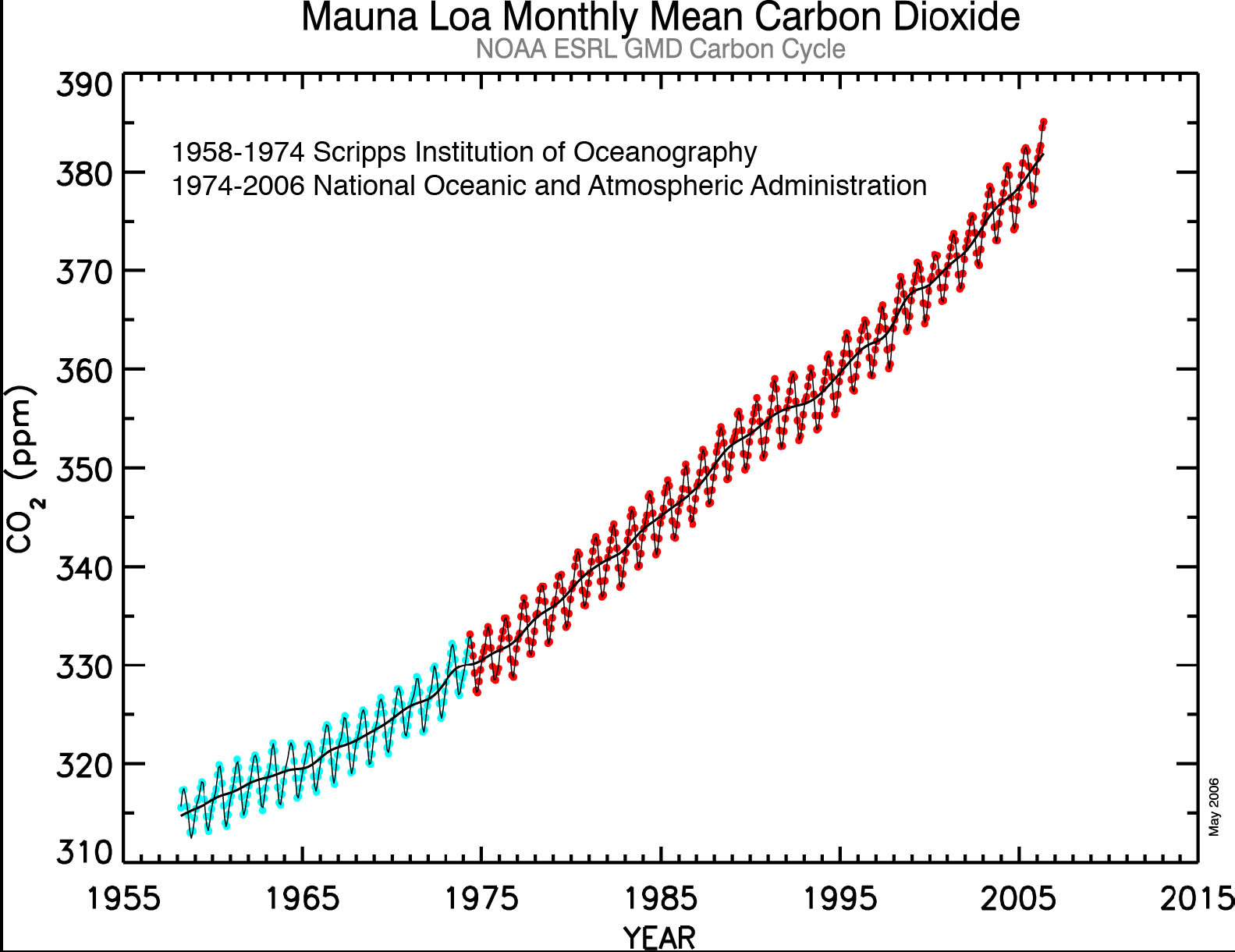
Mauna Loa Observatory
Some of the best evidence I have personally seen and heard comes not from the atmosphere or from sea level temperatures, but from the core of the earth itself. Take a look at what geophysicists from the University of Utah have uncovered by taking the temperature within the earth’s crust.
All of these collected data are have to be put into the context of a model. Several problems exist with models. First, they are only as good as the data they’re based on. Two, they get less accurate as the time scale increases. Third, several projections need to be placed in context with one another to account for natural changes in the climate and changed in human behavior. I don’t think this invalidates models, but do think we need to collect more data and educate people about the necessity and the limits of models. I want to take a minute to look at some of the simpler models from the IPCC 2007 Summary for Policymakers (SPM).
Models can be used in the popular media in a variety of ways. Al Gore used them to make a point and tell a story in An Inconvenient Truth. Glen Beck Dismisses them in his promo for his book, An Inconvenient Book.
The final contextual element deals with who is responsible for climate change and who is going to do something about it. Does the responsibility lie with Individuals?
With Entrepreneurs?
With Educators/Academia?
With Corporations?
With Local Regulatory boards?
With Regional Coalitions?
With the Federal Government?
With Multinational NGOs like the UN, IPCC, or the G20? I really don’t know. But I look forward to thinking more about it and learning more about this human scale.
This week we will focus on the behaviors of individuals and small groups and how that affects green house gas emissions. Next week I hope to gain a regional perspective on energy policy in the context of climate change. Finally, we’ll take a global view of climate change in the context of other issues I have discussed with you: human health and disease, water management, and food systems and food security.
N. Korea Update
N. Korea has, in fact, followed up on its threat/promise and tried to launch a "satellite" into "orbit." Didn't work, exactly, but it has started the geopolitical posturing. Here's the NY Times' account. Note that 1) the test failed, 2) it did extend the possible range N. Korea could launch something, 3) they are years away from intercontinental missile capabilities.
Thursday, April 2, 2009
Blog-On: Culture of Fear
Please mull over one of this week's posts and comment in the comments section of that particular post. Posts in question: Steven Pinker; Axis of Evil/War on Terror; DeLillo on 9/11; WTC-- 9/11.
Steven Pinker on the Decline of Violence
Steven Pinker is a professor of psychology at Harvard. Click here for his Harvard website, which has lots of bio information and interviews, etc. This is a talk he gave at the annual TED conference. TED stands for "Technology, Entertainment, Design" and it's basically a weeklong slew of heady lectures on how to save the world, "progressive" style. Check it out if you're interested at the TED website where all the talks are stored and organized by category.
I guess the two questions re: this particular talk are 1) do you buy that the world is exponentially safer than it was, say, 400 years ago? and 2) if so, why do you think that is? (If not, of course, why not?)
Subscribe to:
Posts (Atom)